
RTO For Automotive OEM Painting Line
Regenerative Thermal Oxidizer (RTO) For Automotive OEM Vehicle Painting Line
Contact an Agent!
Main VOCs
Toluene, xylene, ethyl acetate, acetone, butanol, isopropanol, ethylene glycol ether, etc.
Auxiliary components
Paint mist particles (containing resin and pigments), trace amounts of benzene compounds (BTEX), and trace amounts of heavy metals (from color pastes);
Concentration range
Typically 1,000–8,000 mg/Nm³ (higher for solvent-based coatings, lower for water-based coatings but still requiring treatment).
Industry Background
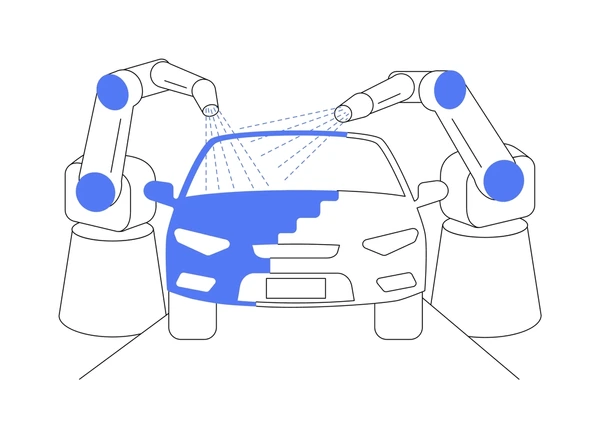
Automobile manufacturing is one of the core pillars of the global industrial system, and OEM painting is one of the most energy-intensive and polluting processes. A typical automotive OEM painting line includes multiple painting processes such as electrophoresis, intermediate coating, color paint, and clear coat, using a large amount of solvent-based or water-based coatings, resulting in high concentrations of volatile organic compounds (VOCs).
With the advancement of global “dual carbon” goals and consumers’ focus on green manufacturing, mainstream automakers (such as Toyota, VW, Ford, and BYD) have all incorporated low-emission, high-efficiency painting exhaust gas treatment into their ESG strategies. Against this backdrop, regenerative thermal oxidizers (RTOs) have become standard equipment in global automotive OEM painting lines due to their high purification efficiency (>95%), high heat recovery rate (>95%), and long-term operational stability.
Main Components & Sources of Exhaust Gas
In automotive OEM painting processes, exhaust gases mainly originate from the following steps:
| Step | Main Exhaust Gas Components | Typical Concentration Range |
| Electrophoretic Primer Drying | Small amounts of alcohols, ethers, and amines (from ultrafiltrate volatilization) | Low concentration (<500 mg/Nm³) |
| Intermediate/Color Coat Spraying | Toluene, xylene, butyl acetate, acetone, butanol, ethylene glycol butyl ether, etc. | Medium to high concentration (1,000–6,000 mg/Nm³) |
| Clear Coat Spraying (Solvent-Based) | High proportion of aromatic hydrocarbons, esters, and ketones | High concentration (3,000–8,000+ mg/Nm³) |
| Waterborne Paint Flash-Drying/Baking | Residual co-solvents (e.g., IPA, DPM), small amounts of VOCs | Medium to low concentration (500–2,000 mg/Nm³) |
| Paint Mist | Resin particles, pigments, and additive particles | Solid content 5–20% |
Note: Although the adoption rate of waterborne coatings is increasing, additives are still needed to improve leveling properties. With 5–15% organic co-solvents, VOC emissions remain significant.
Environmental hazards
VOCs are key precursors to ozone (O₃) and secondary organic aerosols (SOA), exacerbating urban photochemical smog and PM2.5 pollution; some solvents (such as benzene and formaldehyde) are persistent and bioaccumulative, impacting ecosystems.
Health hazards
Toluene and xylene can cause dizziness and liver and kidney damage; Benzene is classified as a Group 1 carcinogen by the IARC; Long-term exposure increases the risk of leukemia and nervous system diseases in workers.
Safety Risks
Most organic solvents have low lower explosive limits (LEL) (e.g., acetone LEL=2.5%), and paint mist mixed with VOCs can easily form an explosive atmosphere; if not effectively controlled, there is a risk of fire or explosion.
Global Regulations and Environmental Requirements
- The *Integrated Emission Standard for Air Pollutants* (GB 16297–1996)
specifies individual limits for benzene (≤12 mg/m³), toluene (≤40 mg/m³), and xylene (≤70 mg/m³).
- The *Standard for Unorganized Emission Control of Volatile Organic Compounds* (GB 37822–2019)
requires closed-loop operation of VOCs materials, collection efficiency ≥80%, and centralized treatment of waste gas.
- The *Technical Specification for Discharge Permits—Automobile Manufacturing Industry* (HJ 1027–2019)
sets the VOCs concentration limit at organized emission outlets at ≤50 mg/m³; in key areas (Beijing-Tianjin-Hebei region, Yangtze River Delta, and Fenwei Plain), the limit is ≤20–30 mg/m³, with a removal efficiency ≥90% (≥95% for new projects).
- The Industrial Emissions Directive (IED, 2010/75/EU)
requires vehicle manufacturers with an annual production capacity of ≥5,000 vehicles to adopt **Best Available Techniques** (BAT).
- **BREF for Surface Treatment** (2019)
VOC emission limits: 20–50 mg/Nm³ (depending on coating type and production capacity)
Solvent consumption limits: such as solvent-based clear coats ≤ 45 g/m² vehicle body area
Mandatory installation of Continuous Emissions Monitoring Systems (CEMS) for large facilities
- EPA NESHAP Subpart XXXII (40 CFR Part 63): VOCs control efficiency ≥95% or emission rate ≤ 0.024 kg VOC/L solids coating. Technical routes are not limited, but RTO and concentration + incineration are the mainstream.
Air Pollution Prevention Law VOCs emission standards: generally ≤ 40 mg/m³
Requires submission of a “VOCs rationalization plan” to promote the application of recovery/incineration technologies. JAMA (Japan Automobile Manufacturers Association) promotes water-based emissions across the industry, with end-of-pipe treatment using RTO or TNV (heat recovery incinerator).
- South Korea: Air Pollution Control Law + TMS system. Key industrial areas (e.g., Gyeonggi Province): VOCs ≤ 30 mg/m³. Companies with annual emissions ≥ 10 tons must install a TMS online monitoring system. Hyundai, Kia, etc., require suppliers to provide high-efficiency waste gas treatment equipment.
- Singapore
NEA under EPMA (2025 Update)
VOCs Limits: 20–50 mg/Nm³ (depending on industry risk level)
Explicitly lists RTO as a BAT (Best in Technology) requirement, requiring new projects to submit technology comparison reports
Mandatory real-time uploading of CEMS data to the NEA platform
- Thailand/Vietnam/Mexico
have relatively lenient national regulations (limits approximately 50–100 mg/m³), but: International automakers (Toyota, Ford, VW, Tesla) implement their home country standards in their overseas factories, and actual projects are generally designed based on ≤50 mg/m³ + ≥90% removal efficiency, making RTO a de facto standard.
Why are More and More Companies Choosing Us?
In today’s world, with increasingly stringent global environmental regulations, high-performance RTOs should not be the exclusive domain of a few giants.
Ever-Power, leveraging the reliability of its global service network, and significant cost advantages, provides global clients in industries such as new energy, automotive, and electronics with a new option for “compliant, efficient, and sustainable” waste gas treatment.
Major Global RTO Brands (2025 Edition)
| Brand (Country/Region) | Core Technology | Key Strengths | Potential Limitations | Best Suited For |
|---|---|---|---|---|
| Dürr (Germany) | Rotary RTO integrated with dry scrubbing (EcoDryScrubber) | Ultra-high thermal efficiency (≥97% heat recovery), seamless integration with paint shops, fully automated | High CAPEX (often >USD 3M), long lead time (6–12 months) | Global OEMs building new greenfield plants with ample budget |
| Anguil (USA) | Modular 3-chamber or rotary RTO with robust explosion protection | Strong safety certifications (FM/ATEX), flexible control logic, mature service in North America | Limited local support in Asia (relies on distributors), slower spare parts delivery | North American compliance projects, high-risk solvent applications |
| Konoike (Japan) | Compact RTO with low-NOx combustion | High reliability, small footprint, low downtime | Limited experience in very large systems (>100,000 m³/h) | Japanese supply chains, space-constrained facilities |
| Zhongtian / VOCs Tech (China) | Standard 3-chamber RTO with domestic ceramic media | Low cost, fast delivery (2–4 months), responsive local service | Fewer international certifications; performance in complex VOC streams less proven | Domestic Chinese SMEs, cost-sensitive projects |
| Ever-Power | Modular RTO + Zeolite Wheel Concentrator + Solvent Recovery System (optimized for NMP, DMF, esters, ketones, etc.) | ✅ 20–30% lower CAPEX vs. Western brands ✅ Standardized modules from 30,000–150,000 m³/h, easily scalable ✅ 316L/310S stainless steel chambers + hybrid honeycomb/structured ceramics to resist corrosion & clogging ✅ Real-time LFL monitoring, redundant burner controls, remote diagnostics—enables unattended operation ✅ Global service hubs in Europe, North America, Southeast Asia & South America; expert support for NMP recovery | Brand recognition still growing internationally (though projects are operational worldwide) | Chinese manufacturers expanding overseas, new energy factories, global projects needing fast deployment + solvent recovery |
Key Performance & Service Comparison
(Based on a typical 100,000 m³/h system)
| Criteria | Dürr | Anguil | Konoike | Zhongtian | Ever-Power |
|---|---|---|---|---|---|
| VOC Destruction Efficiency | ≥98.5% | ≥98% | ≥97% | ≥95% | ≥98% |
| Thermal Recovery Efficiency | ≥97% | ≥95% | ≥94% | ≥92% | ≥95% |
| Lead Time | 6–12 months | 4–8 months | 5–7 months | 2–3 months | 3–5 months |
| Initial Investment (Relative) | 100% | 90% | 85% | 60% | 70–75% |
| Local Technical Support | Limited (HQ-dependent) | Strong in NA, weak in Asia | Strong in Japan/Asia | China only | ✅ Full coverage: Europe, NA, SEA, South America |
| Special Capabilities | Zero-wastewater paint shop integration | High-safety design | Compact footprint | Basic RTO | ✅ Integrated NMP/DMF recovery + wheel concentrator + smart remote O&M |
RTO Cases Study of Automotive Paint Production Line
H****r Specialty Coatings GmbH
- Industry: Manufacturer of high-solids and waterborne OEM automotive coatings
- Location: Lower Saxony, Germany
- Customers: Supplies basecoat/clearcoat systems to Volkswagen Group plants in Germany, Slovakia, and Spain
- German chemical plants are strictly regulated under TA-Luft and **EU Industrial Emissions Directive **(IED).
Challenge:
The plant’s aging two-chamber RTO struggled with:
- VOC emissions at 38 mg/Nm³ (exceeding EU BREF limit of ≤20–30 mg/Nm³)
- Destruction efficiency below 90%, risking non-compliance with VW’s sustainability requirements
- Frequent clogging from pigment dust and high gas consumption
A 2024 audit by local authorities and VW flagged the site for urgent upgrade.
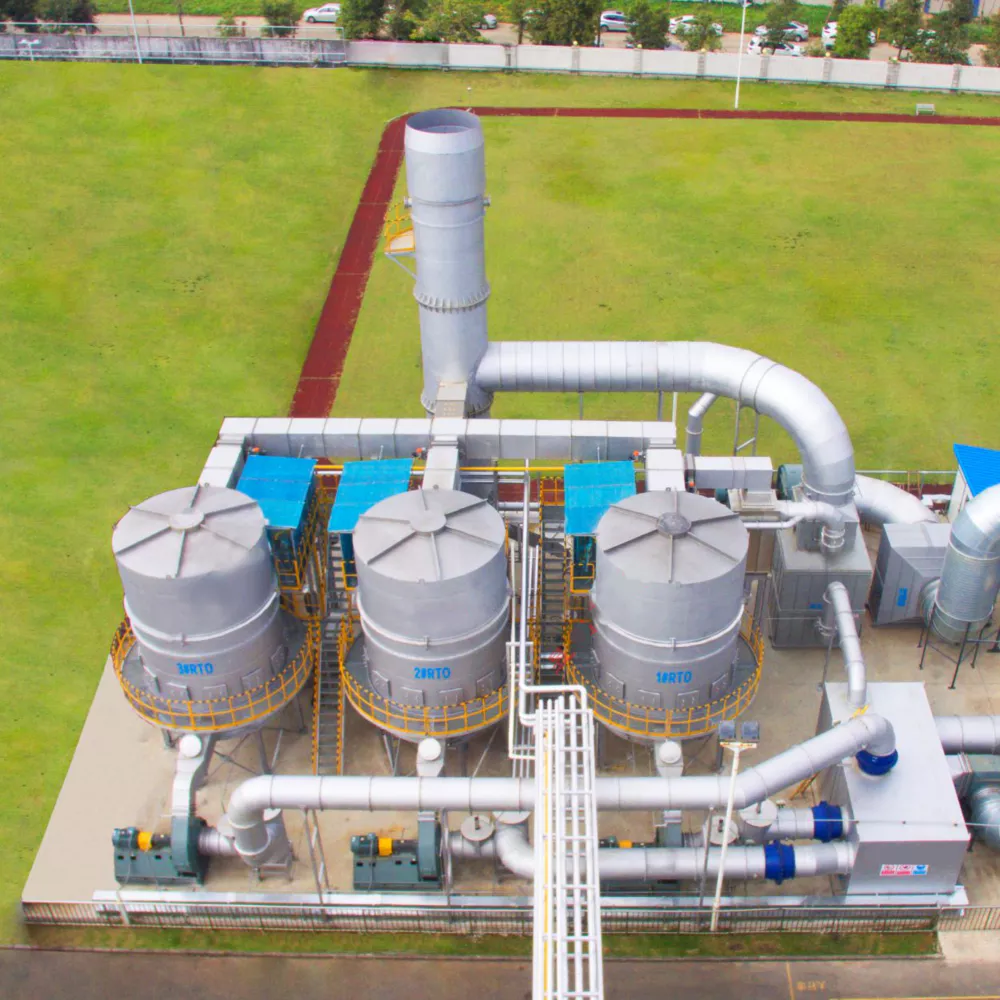
Solution: Ever-Power 3rd-Generation 3-Bed Rotary RTO
After a competitive tender including Dürr and Anguil, Hanover selected Ever-Power based on:
- A 20% lower TCO(Total Cost of Ownership)over 10 years;
- Proven experience in EU chemical plants(including a reference site in Hungary);
- Ability to deliver CE-certified equipment with full EN/IEC compliance;
- Local service support via Ever-Power’s Munich technical hub.
System Specifications:
- Type: 3rd-gen continuously rotating RTO(1.2 rpm)
- Capacity: 35,000 Nm³/h
- Chamber Material: 1.4845(310S)stainless steel, 6 mm thick
- Ceramic Media: Hybrid configuration—structured blocks(bottom 40%)for dust resistance + honeycomb(top 60%)for heat transfer
- Safety: Dual LFL analyzers, NFPA 86-compliant dilution system, SIL2 burner control
- Energy Recovery: ≥95%;excess heat routed to preheat reactor feed via plate heat exchanger
- Digital Integration: Modbus TCP interface to Siemens PCS7 + VW Supplier Sustainability Dashboard
Installation completed in 8 weeks during a scheduled summer maintenance window, with zero safety incidents.
Results:
- VOCs reduced to 12 mg/Nm³
- Destruction efficiency stabilized at 98.6%
- Natural gas use cut by 43% → annual savings of €185,000
- Full compliance achieved; supply contract with VW renewed
“Ever-Power delivered a technically sound, cost-effective solution that meets both EU regulations and our customer’s ESG expectations.”
— Dr. Markus Weber, Technical Director
Author: Miya
 EN
EN  ZH
ZH  ES
ES  AR
AR  ID
ID  PT
PT  FR
FR  JA
JA  RU
RU  DE
DE  MS
MS  CS
CS  BG
BG  NL
NL  KO
KO  RO
RO  SK
SK  TH
TH  VI
VI  ZH_TW
ZH_TW  UK
UK