
Antibiotic Active Pharmaceutical Ingredient (API) Manufacturing: Magnetic Energy Dewhite Emission Control Project Analysis
Engineering Assessment of Pharmaceutical Fermentation and Synthesis Exhaust Treatment with RTO-Compatible Pre-Treatment for VOC and Particulate Co-Removal
1. Project Background and Pharmaceutical Industry Context
This engineering assessment examines an emission control upgrade at an antibiotic active pharmaceutical ingredient (API) manufacturing facility — a joint-stock enterprise designated as one of Shanxi Province’s key production backbone enterprises. Established in 1998, the facility produces 8,000 tons of penicillin annually, with economic and technical indicators ranking among the top tier of domestic pharmaceutical manufacturers.
The global antibiotic market reached $42.32 billion in 2022, with projected growth at a 5.5% compound annual growth rate driven by increasing infectious disease incidence, innovative product development, and expanding antibiotic utilization. Antibiotics remain essential therapeutics for treating bacterial infections in both human and veterinary medicine, effectively killing bacteria or preventing their proliferation. According to research published in The Lancet Regional Health — Southeast Asia in September 2022, the azithromycin 500mg tablet is the most commonly prescribed antibiotic combination in India, followed by cefixime 200mg tablets. The U.S. Centers for Disease Control and Prevention (CDC) documented 7,174 tuberculosis cases in 2020, with millions affected by common infections annually.
The facility’s upgrade imperative: As the pharmaceutical industry maintains stable global growth with China as a primary market, technological innovation and environmental compliance requirements have become critical drivers of industry development. The antibiotic API production process generates complex exhaust streams requiring multi-pollutant control to meet stringent pharmaceutical manufacturing emission standards.
2. Flue Gas Characterization and Pollutant Inventory
Antibiotic API manufacturing — encompassing fermentation, extraction, synthesis, and drying operations — generates exhaust streams with distinctive pharmaceutical pollutant signatures. The baseline environmental assessment for this project reveals the following comprehensive inlet conditions:
| Parameter | Value | Unit | Engineering Significance |
|---|---|---|---|
| Standard Gas Volume Flow | 60,000 | Nm³/h | Moderate scale; typical for pharmaceutical fermentation operations |
| Flue Gas Temperature | 50 | ℃ | Post-SCR temperature; near saturation |
| Oxygen Content (Actual / Baseline) | 14 / — | % | Moderate oxygen; fermentation exhaust characteristic |
| Nitrogen Oxides (NOₓ) | 50 | mg/Nm³ | At special emission limit; SCR pre-treatment required |
| Sulfur Dioxide (SO₂) | 100 | mg/Nm³ | 3.3× over special emission limit; desulfurization required |
| Particulate Matter | 50 | mg/Nm³ | 5× over special emission limit; primary treatment target |
| Carbon Monoxide (CO) | — | mg/Nm³ | Not specified; combustion monitoring recommended |
| Hydrogen Fluoride (HF) | — | mg/Nm³ | Not specified; fluoride monitoring recommended |
| Arsenic (As) | — | mg/Nm³ | Not specified; heavy metal monitoring recommended |
| Inlet Humidity to Dewhite Unit | 50 | % | High moisture; fermentation exhaust characteristic |
Emission Standards (GB 13271-2014 — Boiler Air Pollutant Emission Standard):
| Pollutant | Special Emission Limit | Unit |
|---|---|---|
| Nitrogen Oxides (NOₓ) | 50 | mg/Nm³ |
| Sulfur Dioxide (SO₂) | 30 | mg/Nm³ |
| Particulate Matter | 10 | mg/Nm³ |
| Dewhite (Visual Standard) | No visible white plume | — |
Critical Diagnostic Finding: The particulate loading of 50 mg/m³ and SO₂ concentration of 100 mg/m³ represent 5-fold and 3.3-fold exceedances of special emission standards, respectively. The 50% relative humidity at 50℃ indicates substantial water vapor content from fermentation and drying operations — both a compliance challenge (white plume generation) and a characteristic of pharmaceutical manufacturing exhaust. For facilities evaluating regenerative thermal oxidizer (RTO) systems for VOC-laden pharmaceutical exhaust streams, this moderate pollutant loading with high moisture content suggests that RTO integration requires careful attention to moisture management and ceramic media protection.
3. Process Flow and System Architecture
3.1 Pharmaceutical Manufacturing Exhaust Treatment Sequence
The raw flue gas treatment pathway for this antibiotic API facility follows a multi-stage conditioning sequence: Chain Furnace → Waste Heat Boiler → SCR Denitrification → Desulfurization Tower → Stack Discharge. This existing infrastructure provided the foundation for the magnetic dewhite upgrade.
The technological retrofit introduced several new equipment additions to enhance flue gas treatment efficiency and effectiveness. First, a flue gas condenser was added to reduce exhaust temperature to 40℃. The pre-conditioned flue gas is then conveyed to the magnetic dewhite unit, where magnetic field action performs deep purification and plume elimination to further remove pollutants from the exhaust. Through these two-stage treatment processes, the gas becomes progressively cleaner, ultimately discharging through the existing stack to atmosphere. Additionally, a waste heat utilization heat exchanger was installed, improving energy utilization efficiency while reducing energy waste — achieving the dual objectives of environmental protection and energy conservation.
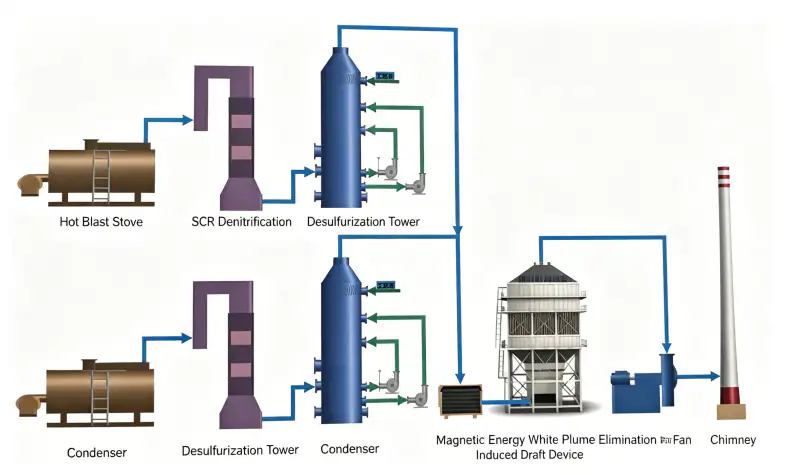
Figure 1: Plant Area Process Flow — Chain furnace exhaust conditioning through waste heat recovery, SCR denitrification, desulfurization, condensation, and magnetic dewhite treatment
3.2 Design Elevation and Physical Layout
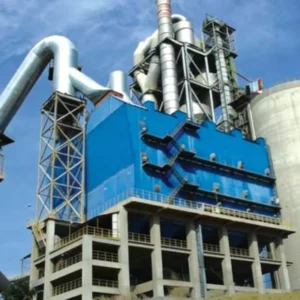
The three-dimensional elevation drawing illustrates the vertical integration of the retrofit components, showing the flue gas condenser, magnetic dewhite unit, and waste heat utilization heat exchanger integrated with the existing desulfurization tower and stack infrastructure:
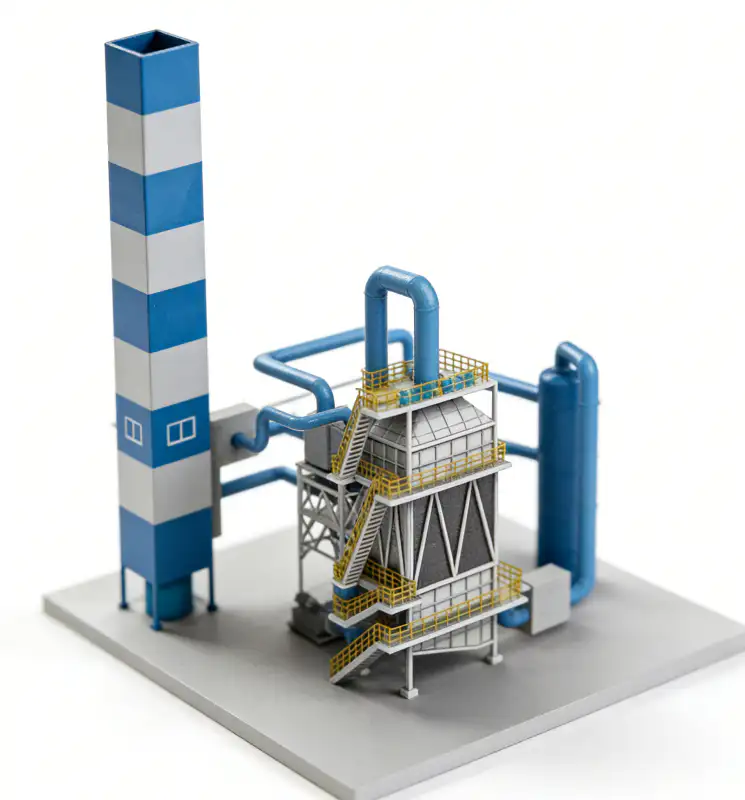
Figure 2: Design Elevation Drawing — 3D visualization of retrofit system integration with existing pharmaceutical manufacturing infrastructure
System Integration Note: The existing treatment train — waste heat boiler, SCR denitrification, and desulfurization tower — provided substantial upstream conditioning for NOₓ and SO₂ control. The retrofit added three stages: flue gas condensation (temperature reduction to 40℃), magnetic dewhite (final particulate and plume control), and waste heat utilization heat exchanger (energy recovery). This approach of leveraging existing environmental infrastructure and adding targeted polishing and energy recovery stages is directly analogous to RTO system retrofit strategies, where existing scrubbers and thermal oxidizers are retained and the RTO is added as a VOC destruction stage with integrated heat recovery.
4. Equipment Specification and Sizing Parameters
The magnetic dewhite unit was sized to handle the conditioned pharmaceutical manufacturing exhaust after SCR denitrification and desulfurization. The following specifications were established:
| Item | Unit | Parameter | Engineering Notes |
|---|---|---|---|
| Unit Model | — | BLCNXB-6W | Compact magnetic energy dewhite unit for pharmaceutical applications |
| Layout Configuration | — | External Split-Mount | Independent of existing desulfurization tower |
| Inlet / Outlet Orientation | — | Lower-Side In, Top Out | Gravity-assisted gas-liquid separation |
| Purification Efficiency | % | 97 | Particulate matter removal rate |
| Inlet Mixed Pollutant Concentration | mg/Nm³ | 50 | Post-desulfurization loading |
| Outlet Mixed Pollutant Concentration | mg/Nm³ | 10 | Meets special emission standard |
| Unit Pressure Drop | Pa | 250 | Minimal impact on existing fan capacity |
| Design Gas Flow Rate | Nm³/h | 60,000 | Matched to conditioned pharmaceutical exhaust |
| Inlet Gas Temperature | ℃ | Approximately 40 | Post-condenser temperature |
| Magnetic Purification Material | — | Graphene Composite | High specific surface area; corrosion-resistant; pharmaceutical-grade |
| Equipment Dimensions (L×W×H) | m×m×m | 6.05 × 6.05 × 18.2 | Compact footprint for 60,000 Nm³/h capacity |
| Magnetic Generator Model | — | BLEMG-1K5 | 1.5 kW-class magnetic energy generator |
Material Selection Rationale: The graphene composite specification for magnetic purification components provides chemical stability and high specific surface area in a compact configuration. The pharmaceutical-grade material selection ensures no contamination of the exhaust stream with foreign substances that could affect product quality or regulatory compliance. For RTO equipment installations in pharmaceutical manufacturing environments, material specifications must similarly ensure that oxidation byproducts do not introduce contaminants into the production environment or surrounding community.
5. Operational Results and Performance Verification
5.1 Commissioning and System Performance
The magnetic dewhite unit achieved full operational success during initial commissioning, with all operating data and dewhite performance metrics meeting design targets and specifications. This outcome validated both the unit’s high efficiency and the reliability of the magnetic energy technology platform for pharmaceutical manufacturing applications.
5.2 Before-and-After Visual Comparison
The visual transformation provides immediate evidence of system effectiveness:
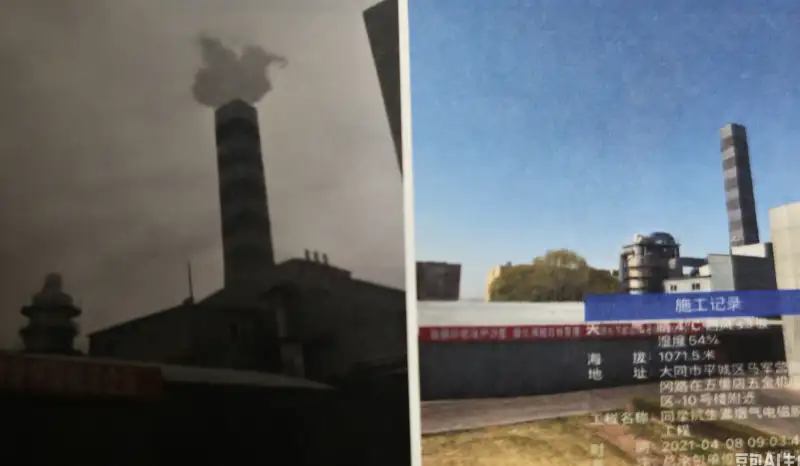
Figure 3: Magnetic Dewhite Device Comparison — System deactivated (left) showing visible white plume versus system activated (right) showing clean stack discharge
The left image captures the stack with the magnetic dewhite system deactivated — a visible white plume is present. The right image, with the system fully operational, shows a clean stack with virtually no visible emission. This visual improvement directly addresses community concerns in the Shanxi region, where environmental awareness is growing and regulatory enforcement is intensifying. For regenerative thermal oxidizer exhaust streams in comparable pharmaceutical applications, comparable post-treatment conditioning and third-party monitoring are essential — pharmaceutical manufacturing facilities face particularly stringent regulatory scrutiny and must maintain comprehensive documentation of emission compliance.
6. Third-Party Emission Monitoring Verification
Independent third-party monitoring was conducted on February 5, 2021, to verify system performance against applicable emission standards. The monitoring data confirms comprehensive compliance across all regulated parameters:
| Monitoring Item | First Test | Second Test | Third Test | Average | Standard Limit | Compliance Status |
|---|---|---|---|---|---|---|
| Standard Dry Flow (m³/h) | ||||||
| Test 1 | 71,135 | 72,193 | 74,098 | 72,163 | — | — |
| Test 2 | 71,173 | 74,494 | 75,475 | 73,775 | — | — |
| Flue Gas Temperature (℃) | ||||||
| Test 1 | 41 | 45 | 40 | 41 | — | — |
| Test 2 | 45 | 42 | 41 | 43 | — | — |
| Oxygen Content (%) | ||||||
| Test 1 | 10.95 | 10.91 | 10.95 | 10.95 | — | — |
| Test 2 | 10.8 | 10.9 | 10.8 | 10.8 | — | — |
| Baseline Oxygen Content (%) | ||||||
| All Tests | 9 | 9 | 9 | 9 | — | — |
| Particulate Matter | ||||||
| Measured Concentration (mg/m³) | 4.5 | 4.9 | 4.8 | 4.8 | — | — |
| Standard Flow Concentration (mg/m³) | 5.5 | 5.3 | 5.7 | 5.7 | 10 | Compliant |
| Smoke Blackness (Ringelmann) | 0.327 | 0.354 | 0.355 | 0.345 | — | — |
| Sulfur Dioxide (SO₂) | ||||||
| Measured Concentration (mg/m³) | 10.6 | 11.3 | 11.1 | 11.0 | — | — |
| Calculated Concentration (mg/m³) | 12.6 | 13.4 | 13.3 | 13.1 | 35 | Compliant |
| Emission Rate (kg/h) | 0.755 | 0.816 | 0.822 | 0.797 | — | — |
| Nitrogen Oxides (NOₓ) | ||||||
| Measured Concentration (mg/m³) | 20.5 | 22.9 | 21.1 | 21.5 | — | — |
| Calculated Concentration (mg/m³) | 21.4 | 27.2 | 25.2 | 25.6 | 50 | Compliant |
| Emission Rate (kg/h) | 1.46 | 1.65 | 1.56 | 1.56 | — | — |
Performance Assessment: All monitored parameters achieved full compliance with applicable standards. Particulate matter averaged 5.7 mg/m³ (standard flow basis) against a 10 mg/m³ limit — a 43% margin below the standard. Sulfur dioxide averaged 13.1 mg/m³ (calculated) against a 35 mg/m³ limit — a 62.6% margin below the standard. Nitrogen oxides averaged 25.6 mg/m³ (calculated) against a 50 mg/m³ limit — a 48.8% margin below the standard. This level of performance demonstrates that the integrated treatment train — waste heat recovery, SCR denitrification, desulfurization, condensation, and magnetic dewhite — achieves not merely compliance but substantial margin for operational variability. For regenerative thermal oxidizer installations in comparable pharmaceutical applications, equivalent multi-stage conditioning with performance margins is essential for reliable long-term compliance.
7. Energy Consumption and Operating Economics
The system operates at a rated power of 53 kW, with annual operating days of 330 days and an average electricity tariff of 0.5 RMB/(kW·h).
Energy Consumption Calculation:
• Annual electricity cost: 53 kW × 24 h × 330 d × 0.5 RMB = 209,800 RMB/year
• Total annual operating cost: approximately 209,800 RMB (20.98万元)
Economic Context: For an antibiotic API facility producing 8,000 tons annually with strong market position, an annual operating cost of approximately 209,800 RMB represents a modest investment in environmental compliance. The integration with the existing waste heat boiler and the added waste heat utilization heat exchanger — which recovers thermal energy from the exhaust stream — further improves overall energy efficiency and reduces net operating costs. When evaluating RTO system economics for pharmaceutical applications, the relatively moderate 53 kW power draw and existing waste heat recovery infrastructure suggest that RTO integration could be economically viable with waste heat recovery offsetting supplemental fuel costs.
8. Operational Risk Assessment and Maintenance Protocols
8.1 Geographic Location and Climate Impact
Datong City, located in the northernmost part of Shanxi Province and bordering multiple counties of the Inner Mongolia Autonomous Region, experiences extremely cold winters and springs. This harsh climate imposes special requirements on equipment operation and maintenance. Under these climatic conditions, ensuring normal equipment operation in low-temperature environments and preventing cold-weather-induced equipment failures or performance degradation is critical. Equipment insulation work is particularly important.
Mitigation: Comprehensive insulation of all external piping, valves, and equipment surfaces. Freeze-protection protocols for condensate drainage systems. Pre-heating sequences for startup after extended shutdown periods. For RTO installations in comparable cold-climate regions, ceramic media pre-heating, burner ignition systems, and condensate management require equivalent cold-weather engineering.
8.2 Absence of Dedicated Dust Collection Equipment and Its Impact
The original flue gas treatment process flow lacked dedicated dust collection equipment, resulting in relatively high dust content in the purified gas after desulfurization tower treatment. This condition not only affected flue gas treatment efficiency but also potentially caused significant fluctuations in sulfide compound emissions,不利于排放的稳定达标. Therefore, adding efficient dust collection equipment is a key measure for improving flue gas treatment quality and reducing environmental pollution.
Mitigation: The magnetic dewhite unit provides effective particulate capture (97% efficiency), compensating for the absence of upstream dedicated dust collection. However, for long-term operational stability and regulatory compliance, installation of a dedicated dust collector system upstream of the desulfurization tower is recommended. For RTO installations, a properly designed dust collector system is absolutely essential — particulate loading above 50 mg/Nm³ will rapidly foul ceramic heat exchange media, degrading thermal efficiency from 97% to below 90% within months.
9. Engineering Insights and Technical Recommendations
This antibiotic API manufacturing facility case study yields several transferable insights for emission control engineering across pharmaceutical and fine chemical industries:
Insight One: Cold Climate Demands Insulation Engineering
The Datong location — with extreme winters bordering Inner Mongolia — demonstrates that emission control equipment cannot be designed for temperate conditions alone. Condensate lines, drain valves, and control systems must be engineered for sub-zero operation. For RTO installations in comparable cold-climate regions, ceramic media housing insulation, burner pre-heat sequences, and stack condensate management require specialized winterization protocols.
Insight Two: Missing Dust Collection Creates Cascade Effects
The absence of dedicated dust collection upstream of desulfurization created not only particulate compliance challenges but also sulfide emission fluctuations — dust particles adsorb and desorb sulfur compounds, creating variable outlet concentrations. This cascade effect demonstrates that emission control must be addressed as an integrated system, not isolated components. For RTO installations, a properly designed dust collector system upstream is non-negotiable for stable ceramic media performance.
Insight Three: Waste Heat Recovery Maximizes Energy Efficiency
The addition of a waste heat utilization heat exchanger — beyond the existing waste heat boiler — demonstrates commitment to energy recovery at every feasible stage. For pharmaceutical facilities with high energy costs, this approach reduces net operating expenses while improving environmental credentials. For RTO installations, integrated waste heat recovery (steam, hot air, thermal oil) can offset 30-50% of operating costs through process heat recovery.
Insight Four: Compact Design Enables Retrofit in Existing Facilities
The 6.05 × 6.05 × 18.2 m dimensions demonstrate that effective emission control can be retrofitted into existing pharmaceutical facilities without major civil works. This is critical for API manufacturers where production continuity is paramount and shutdown windows are limited. For RTO retrofits in comparable facilities, compact rotary configurations with minimal footprint and rapid installation timelines are essential for minimizing production disruption.
Final Assessment: Antibiotic API manufacturing presents a unique emission control challenge — moderate gas volumes (60,000 Nm³/h), high moisture content from fermentation operations, cold-climate operational requirements, and the absence of upstream dust collection infrastructure. The successful application of magnetic energy dewhite technology with integrated condensation and waste heat recovery in this case, achieving 97% purification efficiency and complete white plume elimination while operating at modest 53 kW power draw, demonstrates that integrated physical-field treatment approaches can overcome these challenges economically. For facilities evaluating regenerative thermal oxidizer (RTO) systems for VOC control in comparable pharmaceutical manufacturing environments, the lessons from this case — cold-climate insulation, dust collector system integration, waste heat recovery sequencing, and compact retrofit design — provide a proven framework for successful project execution.
Regenerative Thermal Oxidizer (RTO) Integration for Pharmaceutical API Manufacturing Facilities
For antibiotic API and pharmaceutical manufacturing facilities evaluating regenerative thermal oxidizer technology, the engineering principles from this case study carry direct applicability:
RTO Pre-Treatment for Pharmaceutical Fermentation Exhaust
Pharmaceutical fermentation exhaust at 60,000 Nm³/h with 50 mg/Nm³ particulates and 100 mg/Nm³ SO₂ requires moderate pre-treatment before RTO integration. The existing waste heat boiler, SCR denitrification, and desulfurization tower provide substantial upstream conditioning. Ever-power RTO systems are engineered to accept pre-conditioned streams with particulate loading below 10 mg/Nm³, making this case’s magnetic dewhite output directly compatible with RTO inlet requirements.
Dust Collector System Integration with RTO for Pharmaceutical Applications
The absence of dedicated dust collection in this case study highlights a critical gap that must be addressed for RTO integration. A properly designed dust collector system must be installed upstream of the desulfurization tower to reduce raw particulate loading from 50 mg/Nm³ to below 20 mg/Nm³ before desulfurization, with magnetic dewhite providing final polishing to 10 mg/Nm³. For pharmaceutical applications, the dust collector system must also prevent cross-contamination between product batches.
RTO Waste Heat Recovery for Pharmaceutical Energy Management
The 53 kW operating load of this magnetic dewhite system could be substantially offset by integrating RTO waste heat recovery. Ever-power RTO systems with 97% thermal efficiency and integrated hot air or steam recovery can provide process heat for fermentation temperature control, drying operations, or facility heating — reducing overall pharmaceutical manufacturing energy costs. The existing waste heat boiler and added heat exchanger in this case demonstrate the facility’s energy recovery philosophy that RTO integration would extend.
RTO Compliance for Pharmaceutical Manufacturing Emission Standards
Pharmaceutical API facilities must comply with GB 13271-2014 and increasingly stringent local standards for particulates, acid gases, and VOCs. A standalone RTO addresses VOC and organic solvent destruction but must be paired with particulate and acid gas control (as demonstrated in this case) to achieve full regulatory compliance. The integrated approach — dust collector system + SCR + desulfurization + condensation + magnetic dewhite + RTO — represents the comprehensive emission control architecture for modern pharmaceutical manufacturing.
Frequently Asked Questions: Pharmaceutical API Emission Control and RTO Systems
What is the best emission control technology for antibiotic API manufacturing?
For antibiotic API facilities with fermentation and synthesis operations and 60,000 Nm³/h exhaust volumes, the optimal configuration combines waste heat recovery, SCR denitrification, wet desulfurization, flue gas condensation, and magnetic energy dewhite technology for particulate capture and plume elimination. For VOC co-emissions from organic process additives or fuel combustion, integration with a regenerative thermal oxidizer (RTO) provides comprehensive thermal destruction at 99.9%+ efficiency, ensuring complete elimination of pharmaceutical-active compounds from exhaust streams.
Can RTO systems handle pharmaceutical fermentation exhaust with high moisture content?
Standard RTO ceramic media can handle moderate moisture content, but pharmaceutical fermentation exhaust at 50% relative humidity requires careful management. With proper upstream conditioning — as documented in this case study achieving condensation pre-treatment and 97% particulate removal — RTO systems can safely process conditioned pharmaceutical exhaust. Key requirements include: inlet moisture content below 30% relative humidity (achieved through condensation), particulate loading below 10 mg/Nm³, and acid gas neutralization to pH 6-8. For high-moisture applications, RTO ceramic media with wide cell openings resist condensate fouling better than dense configurations.
How does magnetic dewhite technology compare to activated carbon for pharmaceutical VOC removal?
Magnetic dewhite systems excel at particulate capture and water vapor removal but do not address VOC destruction. Activated carbon adsorption captures VOCs but requires frequent replacement and generates hazardous waste. For comprehensive pharmaceutical emission control, the optimal approach combines magnetic dewhite for particulate and plume control with RTO thermal oxidation for VOC destruction. This integrated approach eliminates both visible emissions and organic compound discharge, achieving full regulatory compliance without generating secondary waste streams.
What is the typical ROI for pharmaceutical API emission control upgrades?
Based on this case study’s operating data (annual electricity cost ~209,800 RMB for 53 kW system), payback periods typically range from 18-36 months when factoring in avoided regulatory penalties, eliminated production restrictions, and enhanced facility reputation. For pharmaceutical facilities facing GB 13271-2014 compliance deadlines or Good Manufacturing Practice (GMP) environmental audits, the payback is effectively immediate — non-compliance can trigger production suspension or export license revocation. Integration with RTO waste heat recovery can further improve economics by generating process steam for sterilization or drying operations.
How do I select the right dust collector system for pharmaceutical RTO pre-treatment?
For pharmaceutical API facilities requiring RTO integration, the dust collector system must achieve particulate loading below 50 mg/Nm³ at the RTO inlet, with magnetic dewhite or wet scrubbing providing final polishing to 10 mg/Nm³. For pharmaceutical applications, the dust collector system must prevent cross-contamination between product batches — stainless steel construction, clean-in-place (CIP) capability, and validated cleaning protocols are essential. Bag filters with pharmaceutical-grade media or HEPA-grade final filters are typically specified to ensure both emission compliance and product quality protection.
What are the key design considerations for RTO systems in cold-climate pharmaceutical facilities?
Pharmaceutical facilities in cold climates like Datong (bordering Inner Mongolia) face unique challenges for RTO operation: ceramic media pre-heating requirements, condensate freeze protection, burner ignition reliability at low temperatures, and stack plume visibility in cold air. For regenerative thermal oxidizer installations in comparable cold-climate pharmaceutical facilities, design must incorporate: insulated ceramic media housings, trace-heated condensate lines, pre-heated combustion air systems, and enhanced stack height to disperse plumes above temperature inversion layers. Cold-weather startup sequences and winterization protocols should be specified as standard equipment features, not afterthought add-ons.
 EN
EN  ZH
ZH  ES
ES  AR
AR  ID
ID  PT
PT  FR
FR  JA
JA  RU
RU  DE
DE  MS
MS  CS
CS  BG
BG  NL
NL  KO
KO  RO
RO  SK
SK  TH
TH  VI
VI  ZH_TW
ZH_TW  UK
UK