
Catalytic Oxidizer (CO)
Aromatics
Oxygenated Hydrocarbons
Alkanes & Alkenes
Contains catalyst poisons
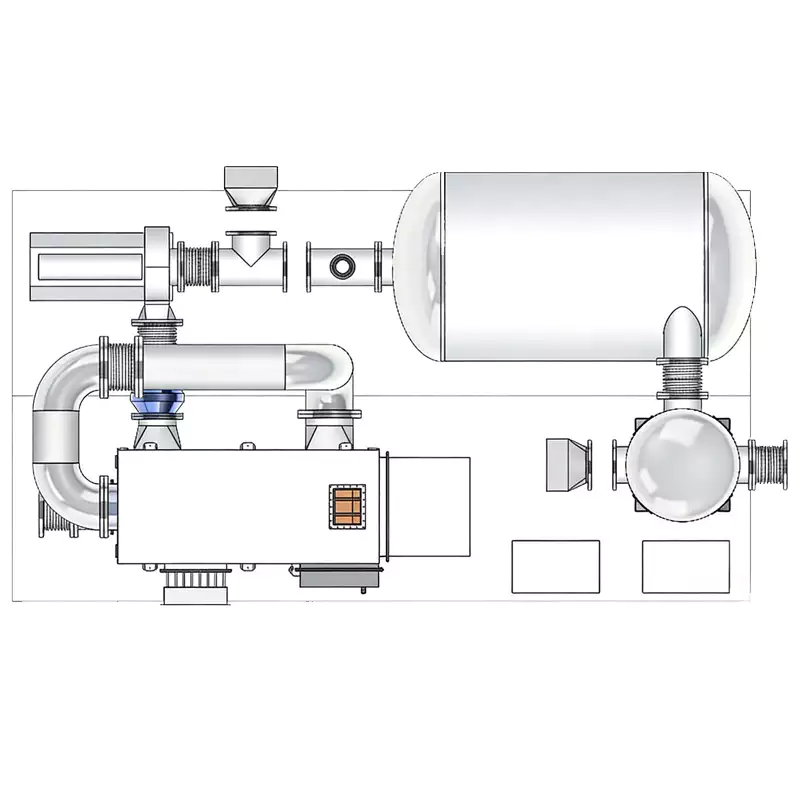
Catalytic Combustion (CO) Furnace
Engineered for high-efficiency VOC destruction and optimal thermal recovery. Ensure strict environmental compliance while drastically driving down operational costs across diverse industries.
Explore Details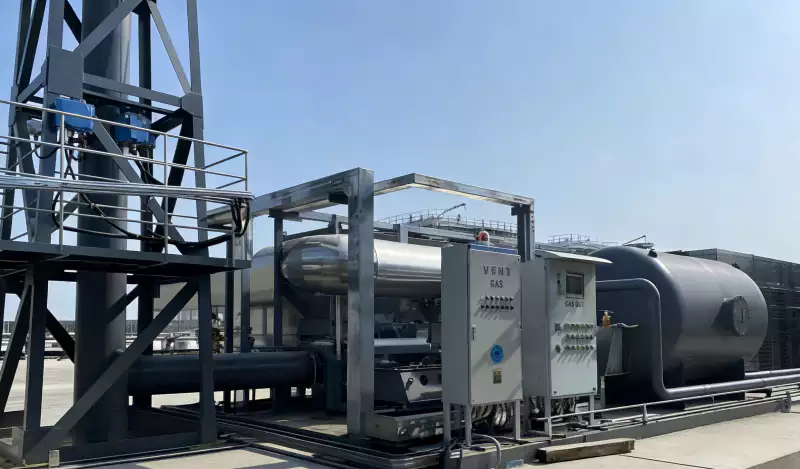
CO Device for Oil Tank Area Waste Gas
A specialized catalytic combustion device strictly engineered for the unique safety and volatility requirements of treating high-concentration waste gas specifically in oil tank areas.
Explore Details
High-efficiency Catalytic Oxidizer – Ever-power CO
Catalytic oxidizers (CO) utilize highly efficient catalysts to completely oxidize volatile organic compounds (VOCs) into harmless CO₂ and H₂O at low temperatures of 250–400°C, avoiding the high energy consumption and NOₓ generation problems of traditional high-temperature incineration. As a key technology for industrial waste gas treatment, CO is particularly suitable for scenarios involving low to medium concentrations of organic waste gas with clearly defined components and high cleanliness.
The Ever-power CO system employs customized anti-poisoning catalysts, intelligent temperature control logic, and a compact design, ensuring a removal efficiency of ≥98% while significantly reducing fuel consumption and operation and maintenance costs. It requires no heat storage structure, resulting in lower investment and faster deployment—providing a cost-effective and highly reliable green solution for industries such as pharmaceuticals, electronics, and printing.
What is Catalytic Oxidizer (CO)
A Catalytic Oxidizer (CO) is an air pollution control device that uses a catalyst to oxidize volatile organic compounds (VOCs) and hazardous air pollutants (HAPs) into carbon dioxide (CO₂) and water (H₂O) at lower temperatures. Compared to traditional thermal combustion, CO achieves high purification efficiency without the need for high temperatures, making it an ideal solution for medium-to-low concentration, clean organic emissions.
Key Mechanism: The catalyst lowers the activation energy required for VOC oxidation, allowing the reaction to proceed rapidly at temperatures far below the auto-ignition point (typically 600–800°C).
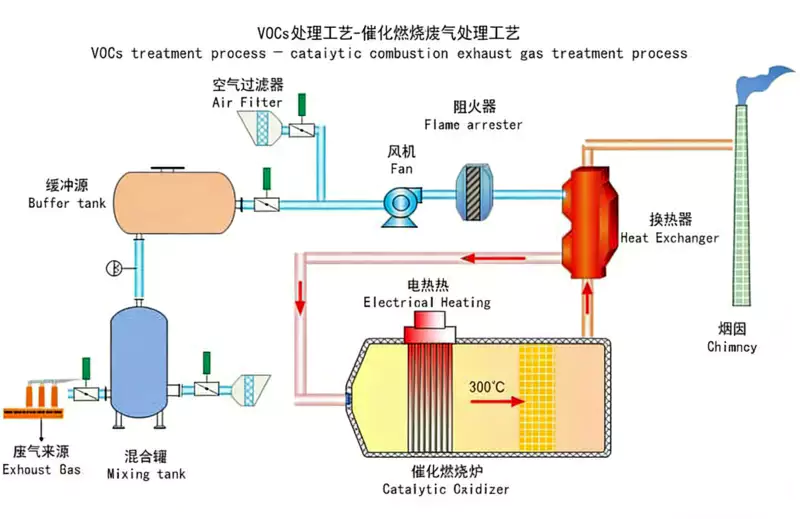
Catalytic Combustion Process
Our BL-CO series furnace integrates design, manufacturing, installation, and commissioning. It represents internationally leading advanced equipment in the fields of environmental protection and energy recovery.
-
High Stability & Efficiency: Continuous optimization in industrial projects ensures a highly rational structure, stable operation, and exceptional processing efficiency.
-
Strict Compliance: Fully capable of meeting various rigorous environmental protection and energy efficiency standards.
-
Wide Application: Extensively utilized across industries such as chemicals, coking, pharmaceuticals, spraying, and printing.
-
Dual Benefits: Achieves highly efficient and safe treatment of VOCs and carbon monoxide alongside valuable energy recovery and utilization.
For a typical VOC like acetone (C₃H₆O):
C₃H₆O + 4O₂ → 3CO₂ + 3H₂O + Heat
General reaction equation:
VOC + O₂ → CO₂ + H₂O + Thermal Energy
Working Mechanism of Catalytic Oxidation
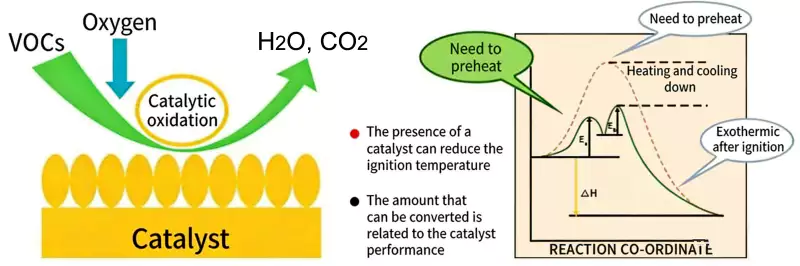
The key to the catalytic oxidation process is that the catalyst lowers the energy barrier of the reaction. Its working mechanism can be summarized in the following five key steps.
Technical Features (CO vs. RTO/RCO)
⚠️ Note: CO requires high intake air cleanliness and is not suitable for exhaust gases containing halogens, sulfur, silicon, dust, or oil mist. For complex exhaust gases, it is recommended to use a pretreatment system or select RTO/RCO.
Low-temperature operation
Significant energy savings, avoiding high-temperature safety hazards
High removal efficiency
Up to 95–99% for applicable VOCs
Compact structure
Flexible installation, suitable for space-constrained scenarios
Zero NOₓ emissions
Strong environmental compliance
Quick start-stop
Suitable for intermittent production conditions
Which Gases are Suitable for CO Treatment?
❌ Not Suitable or High-Risk Gases (Generally not suitable for direct use in CO; pre-treatment or RTO is recommended):
- Halogenated Compounds: Chlorobenzene, Dichloromethane, Freon (Generate corrosive acids, poison catalyst)
- Sulfur Compounds: H₂S, Mercaptans, SO₂ (Cause permanent deactivation of catalyst)
- Siloxanes/Silicones: From defoamers, sealants (Generate silica at high temperatures, clog catalyst beds)
- Phosphorus Compounds, Heavy Metal Vapors: Catalyst poisons
- High Concentrations of Particulates, Oil Mist, Tar: Physical blockage of catalyst bed
✅ Prerequisites: The exhaust gas must be clean, dry, free from catalyst poisons, with VOC concentrations typically within the range of 200–3,000 mg/m³.
CO2 Customized Design
Tailor-made Solutions for Your Exhaust Gases
Gas Composition Analysis
- Identify VOC species, concentration ranges, fluctuation patterns, and potential catalyst poisons (e.g., Cl, S, Si) via GC-MS, FTIR, or on-site sampling.
- Determine suitability for catalytic oxidation and assess catalyst poisoning risks.
Operating Condition Review
- Capture dynamic parameters: airflow (Nm³/h), temperature, humidity, pressure, LEL (Lower Explosive Limit).
- Understand production mode (continuous vs. batch), startup/shutdown frequency, and peak emission periods.
Site & Interface Assessment
- Evaluate available space, lifting constraints, and foundation load capacity.
- Confirm integration requirements with existing infrastructure: ducting, fans, stack, electrical systems (flange standards, control signals, etc.).
Catalyst Compatibility Evaluation
- Select optimal catalyst formulation: precious metal (Pt/Pd) or non-precious alternatives, based on gas composition.
- Customize anti-poisoning or anti-coking formulations for challenging components (e.g., amines, aldehydes).
System Configuration Customization
- Choose heat exchanger type (plate or shell-and-tube), heating method (electric or natural gas), and safety interlocks (LEL monitoring, dilution system).
- Integrate optional features: CEMS, remote diagnostics, explosion-proof design (ATEX/SIL2).
Performance Simulation & Validation
- Use thermodynamic modeling to simulate light-off temperature, fuel consumption, and destruction efficiency.
- Deliver third-party verifiable performance guarantees (e.g., ≥98% DRE, emissions ≤XX mg/m³).
Case Study: Ever-power CO2 helps a South Korean semiconductor packaging plant achieve green compliance by efficiently treating electronic cleaning exhaust gases.
- SemiCore Co., Ltd. (pseudonym, to protect customer privacy)
- Location: Gyeonggi Province
Background
SemiCore is a mid-sized manufacturer specializing in advanced chip packaging (such as Fan-Out WLP and SiP). Its cleaning processes heavily utilize isopropanol (IPA) and acetone as photoresist removers. With the implementation of the 2023 amendment to South Korea’s Atmospheric Environment Protection Act, VOC emission limits have been tightened to ≤50 mg/m³. Existing activated carbon adsorption systems are no longer sufficient to meet these standards and suffer from high hazardous waste disposal costs and frequent replacements.
Key Challenges
- The exhaust gas composition is complex but clean: mainly IPA (~800 mg/m³) and acetone (~400 mg/m³), halogen-free/sulfur-free, but with large humidity fluctuations (30–70% RH).
- Space is extremely limited: the plant is a converted workshop, with only a 3m × 4m installation area reserved.
- High production continuity requirements: the equipment needs to support 24/7 operation, with a downtime window of <8 hours.
- Budget sensitive: the customer wants to keep CAPEX within 60% of the RTO (Recovery To Take) plan while complying with regulations.
How to find Ever-power
The client learned about Ever-power’s numerous successful VOC treatment cases in the electronics industry through LinkedIn technical articles and proactively contacted our Korean distributor. After initial technical discussions, it was confirmed that their exhaust gas was fully compatible with CO technology, and the client subsequently invited the Ever-power engineering team to conduct an on-site survey.
Our Solution
Equipment Model: EP-CO-5000 (Airflow Capacity: 5,000 Nm³/h)
Core Technology Configuration:
Dual-channel plate heat exchanger (heat recovery efficiency ≥92%)
Moisture-resistant Pt/Pd catalyst (optimized for high humidity IPA/acetone)
Electric heating assistance + LEL safety interlock (explosion-proof rating ATEX Zone 2)
Skirt-mounted design (overall dimensions 2.8m × 3.5m × 2.6m, meeting site limitations)
PLC automatic control + remote monitoring platform (supports Korean interface)
Delivery Time: 10 weeks (including sea freight and customs clearance)
Results After Implementation
Client Testimonial
“Ever-power’s CO system not only helped us pass Korea’s Ministry of Environment compliance inspection on the first attempt, but also significantly reduced our operational burden. The remote diagnostics feature allows us to monitor equipment status even outside working hours—truly ‘install and forget.’
— Kim Min-jae
EHS Manager, SemiCore Co., Ltd.
 EN
EN  ZH
ZH  ES
ES  AR
AR  ID
ID  PT
PT  FR
FR  JA
JA  RU
RU  DE
DE  MS
MS  CS
CS  BG
BG  NL
NL  KO
KO  RO
RO  SK
SK  TH
TH  VI
VI  ZH_TW
ZH_TW  UK
UK