
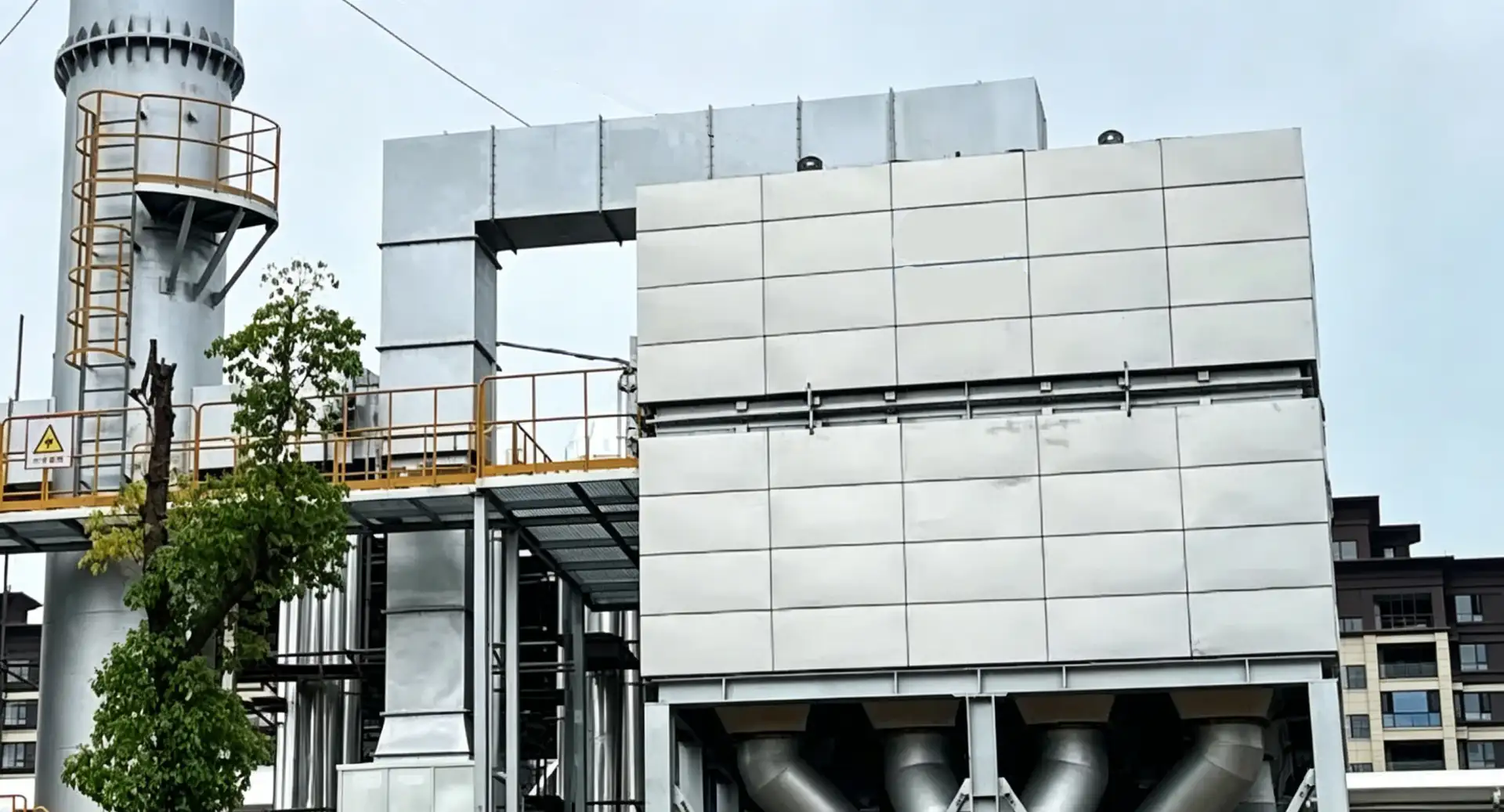
Bed RTO | Bed Type Regenerative Thermal Oxidizer for VOC Treatment
Bed Type Regenerative Thermal Oxidizer (Bed RTO) is an energy-efficient VOC treatment system designed for industrial exhaust gas purification. It uses ceramic heat recovery beds to preheat incoming VOC-laden air and oxidize pollutants at high temperature, helping reduce emissions, fuel consumption and operating costs.
What Is a Bed Type RTO?
Bed Type Regenerative Thermal Oxidizer is a thermal oxidation device that treats industrial VOCs, organic exhaust gases, odors, and certain hazardous air pollutants through high-temperature combustion and ceramic heat recovery.
How Bed RTO Works
Bed RTO is a type of Regenerative Thermal Oxidizer that uses fixed ceramic heat storage beds to recover and reuse thermal energy, dramatically reducing fuel consumption while achieving high VOC destruction rates.
- 1 Fixed Ceramic Heat Storage Beds: The system uses 2 to 5 fixed ceramic-packed beds arranged in a chamber. These beds absorb and store heat from the hot exhaust gas during the outlet cycle.
- 2 Valve-Switching Cycle Operation: Pneumatic switching valves alternate the flow direction, cycling each bed between inlet (preheating), outlet (heat recovery), and purge (cleaning) phases.
- 3 High-Temperature Oxidation: Preheated VOC-laden air enters the combustion chamber at 760-870°C, where pollutants are oxidized into CO2 and H2O with 95-99% destruction efficiency.
- 4 Heat Recovery & Reuse: Clean hot exhaust passes through the opposite bed, transferring its heat to the ceramic media. This stored heat preheats the next incoming cycle, achieving 90-95% thermal efficiency.
- 5 Purge Cycle (3+ Bed Systems): In 3-bed and 5-bed designs, a dedicated purge cycle blows trapped VOCs from the bed back to the inlet, eliminating emission spikes and improving overall purification.
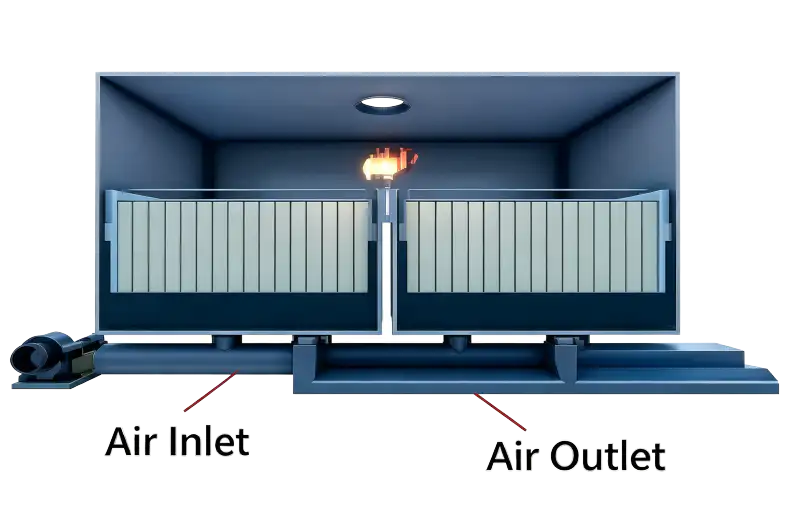
2-Bed RTO
The simplest and most cost-effective design with two ceramic beds alternating between inlet and outlet. Economical for small to medium VOC loads but produces periodic emission spikes during valve switching.
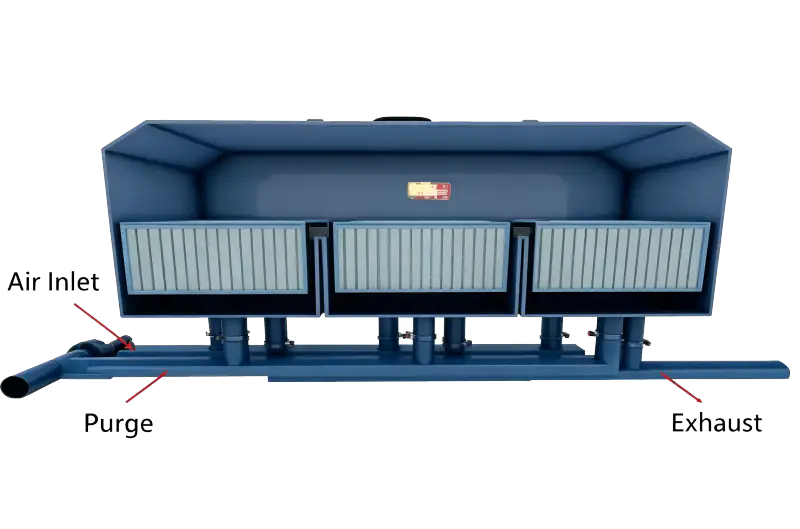
3-Bed RTO
The industry standard balancing performance and cost. Three beds operate in inlet, outlet, and purge cycles simultaneously. The purge cycle eliminates emission spikes, achieving 99% purification efficiency with stable operation.
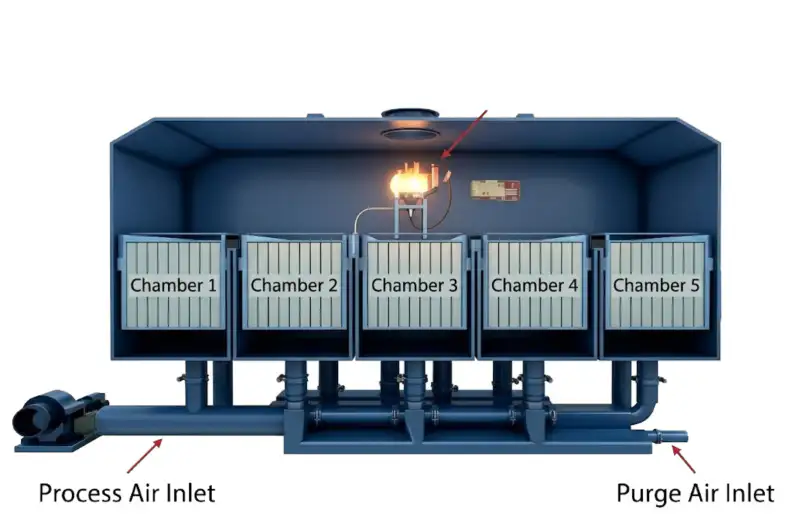
5-Bed RTO
Advanced design for large-scale continuous operations with stringent emission limits. Five beds provide extended heat recovery surface, smoother flow transitions, and higher thermal efficiency for demanding industrial applications.
Bed RTO Type Comparison
| Parameter | 2-Bed RTO | 3-Bed RTO | 5-Bed RTO |
|---|---|---|---|
| Purification Efficiency | 95% | 99% | 99.5% |
| Thermal Efficiency | 90% | 95% | 97% |
| Emission Spikes | Present during switching | Eliminated by purge cycle | Minimal, highly stable |
| Footprint | Compact (100% baseline) | Medium (130%) | Large (160%) |
| Best For | Budget projects, moderate loads | Most industrial applications | Large continuous operations |
| Investment Cost | Lowest | Moderate | Higher |
How Bed Type RTO Works
Bed RTO uses ceramic heat storage beds and cyclic valve switching to preheat VOC-laden exhaust, oxidize pollutants at high temperature, and recover thermal energy for continuous, fuel-efficient operation.
Bed RTO Working Principle
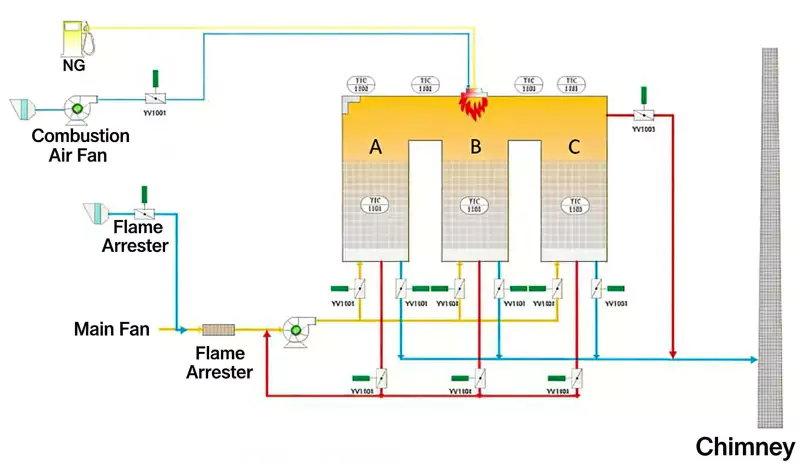
4-Step Thermal Oxidation Cycle
Understanding the continuous cycle that makes Bed RTO highly efficient
Inlet Preheating
VOC-laden exhaust enters through the inlet valve and flows upward through the hot ceramic bed (Bed A), absorbing stored heat and rising to 700-800°C before entering the combustion chamber.
High-Temp Oxidation
Preheated gas enters the central combustion chamber where a burner maintains 760-870°C. VOCs and organic compounds are oxidized into harmless CO2 and H2O with 95-99% destruction efficiency.
Heat Recovery
Clean hot exhaust exits the combustion chamber and flows downward through the opposite ceramic bed (Bed B), transferring its thermal energy to the ceramic media for the next cycle.
Valve Switch & Purge
Pneumatic valves switch flow direction every 60-180 seconds. In 3+ bed systems, a purge cycle blows residual VOCs from the switching bed back to the inlet, eliminating emission spikes.
Main Components of Bed Type RTO
Each component of the Bed RTO is engineered for maximum thermal efficiency, operational reliability, and long service life. Click each component to explore its function and technical specifications.
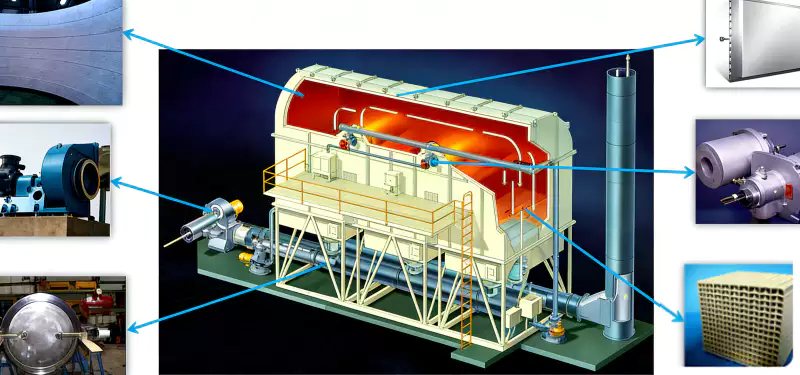
Insulation System
Multi-layer high-temperature insulation lining combines ceramic fiber modules with refractory bricks to minimize heat loss through chamber walls. Our proprietary vacuum-insulated shell design reduces external surface temperature to below 60°C, improving overall thermal efficiency by up to 15% compared to conventional insulation systems.
- Ceramic fiber blanket: 1260°C rating, 128 kg/m3 density
- Refractory brick lining: alumina-silica composition
- Vacuum insulation panel: thermal conductivity 0.004 W/mK
- External cladding: galvanized steel with weatherproof coating
Valve System
Pneumatically actuated high-temperature butterfly valves with ceramic-lined seats switch exhaust flow direction between beds every 60-180 seconds. Precision-engineered for over 1 million cycles, ensuring reliable direction changes with minimal leakage and reduced maintenance downtime.
- Actuator: double-acting pneumatic cylinder with positioner
- Seat material: reaction-bonded silicon carbide (RBSiC)
- Switching time: 2-5 seconds per valve
- Leakage rate: <0.1% of rated flow at operating temperature
- Maintenance interval: 12-18 months depending on duty cycle
Regenerative Media (Ceramic)
Structured honeycomb or saddle-shaped ceramic packing with high specific surface area (300-600 m2/m3) and thermal mass. Cordierite or alumina-mullite composition withstands thermal shock up to 1,000°C, storing and releasing heat with 90-95% recovery efficiency per cycle.
- Material options: cordierite, mullite, alumina (95% Al2O3)
- Cell density: 100-300 cells per square inch (CPSI)
- Wall thickness: 0.3-0.6 mm for optimal heat transfer
- Crush strength: >15 MPa axial, >3 MPa lateral
- Service life: 5-10 years under normal operating conditions
Burner System
Low-NOx natural gas or LPG burner with electronic flame safeguard and precise air-fuel ratio control. The modulating burner automatically adjusts output based on inlet VOC concentration, maintaining 760-870°C combustion temperature with minimal supplemental fuel once auto-thermal conditions are achieved.
- Fuel: natural gas, LPG, or diesel (dual-fuel optional)
- NOx emission: <50 mg/m3 with low-NOx design
- Turndown ratio: 10:1 for precise temperature control
- Ignition: high-voltage spark with UV flame detector
- Auto-thermal mode: fuel consumption drops to near-zero at high VOC loading
Fan System
High-efficiency centrifugal exhaust fan with variable frequency drive (VFD) matches system airflow to process demand in real-time. Corrosion-resistant alloy construction handles hot, corrosive exhaust gases. Inlet guide vane or VFD control maintains precise draft and prevents pressure fluctuations that could affect combustion stability.
- Type: backward-curved centrifugal with VFD control
- Material: SS316L or duplex stainless steel options
- Bearing: heavy-duty spherical roller bearings, oil-lubricated
- Vibration monitoring: ISO 10816 standard alarm thresholds
- Efficiency: >82% at design operating point
Rupture Disc & Instrumentation / Control
Safety rupture disc provides overpressure protection per ASME standards. The PLC-based control system with HMI touchscreen monitors temperature, pressure, flow, and VOC concentration in real-time. Integrated alarm system triggers automatic safe-shutdown sequences for any abnormal condition.
- Rupture disc: ASME VIII certified, burst pressure 1.5x design pressure
- PLC: Siemens S7-1500 or Allen-Bradley ControlLogix
- HMI: 15-inch industrial touchscreen with trend logging
- Sensors: thermocouples (K-type), pressure transmitters, mass flow meters
- Remote monitoring: 4G/WiFi cloud connectivity for diagnostics
- Safety: SIL-2 rated emergency shutdown system (ESD)
Key Features of Bed Type RTO
Ever-Power Bed Type RTO combines advanced thermal engineering with intelligent automation to deliver unmatched VOC destruction performance, energy efficiency, and operational reliability across diverse industrial applications.
Intelligent PLC Control
Advanced PLC-based automatic control system ensures stable, reliable operation under varying process conditions. Precise monitoring and real-time adjustment of combustion temperature, airflow, and valve timing maintain optimal performance while minimizing fuel consumption.
- + Siemens S7-1500 / Allen-Bradley ControlLogix platform
- + 15-inch industrial HMI with real-time trend visualization
- + Auto-thermal mode reduces fuel to near-zero at high VOC loading
- + Remote diagnostics via 4G/WiFi cloud connectivity
Multi-Chamber Ceramic Recovery
Three or more regenerative chambers filled with high-performance ceramic media facilitate direct heat exchange with exhaust gas. Specially selected cordierite and alumina-mullite ceramics deliver exceptional thermal conductivity and durability, maximizing heat recovery while reducing operating costs.
- + 300-600 m2/m3 specific surface area for maximum heat transfer
- + 90-95% thermal efficiency per cycle
- + 5-10 year service life under normal operating conditions
- + Rapid heating and cooling cycles for continuous operation
Precision Poppet Valve System
Multiple pneumatically actuated poppet valves provide quick, reliable switching between heat storage and release functions. Ceramic-lined seats ensure minimal pressure drop and excellent sealing properties even at high temperatures, maintaining heat exchange integrity and preventing emission leaks.
- + >1 million cycle life with minimal maintenance
- + Reaction-bonded silicon carbide (RBSiC) valve seats
- + 2-5 second switching time with <0.1% leakage
- + Suitable for demanding applications: incineration, petrochemical
Customization & Adaptability
RTO equipment is fully customizable to specific site requirements, with dimensions tailored to available space constraints. The system exhibits strong adaptability for complex operating conditions involving high-concentration and multi-component exhaust gases, accommodating fluctuations in gas composition and volume while ensuring consistent performance.
- + Tailored dimensions for retrofit and greenfield projects
- + Modular design simplifies transportation and installation
- + Handles varying exhaust gas flows and integration with other systems
- + Proven across pharmaceuticals, food processing, coatings, and chemicals
2-Bed RTO vs 5-Bed RTO: Which One Should You Choose?
From the foundational 2-Bed design to the advanced 5-Bed configuration, explore the evolution of thermal oxidation technology to match your emission control needs.
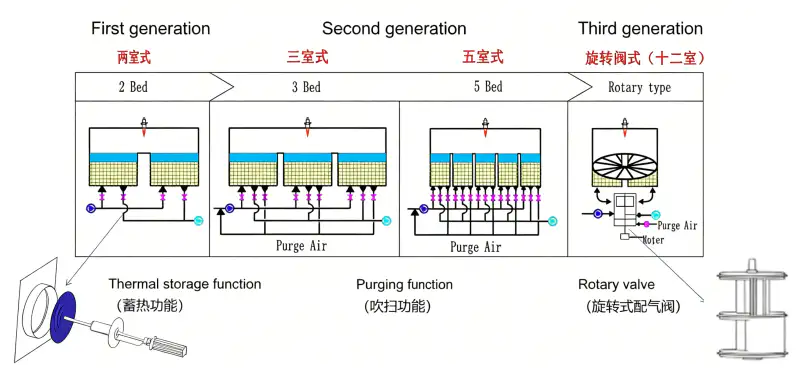
2-Bed RTO
The foundational dual-chamber design offering reliable thermal oxidation. Ideal for straightforward applications with moderate VOC concentrations and lower flow rates.
- Dual ceramic heat exchange beds
- Cost-effective entry solution
- Simple valve switching logic
- Suitable for basic compliance
3-Bed RTO
The industry standard bridging efficiency and cost. The dedicated purge chamber eliminates VOC escape during valve switching, achieving higher destruction efficiency.
- Integrated purge chamber
- Prevents VOC leakage
- Higher DRE (Destruction Rate)
- Balanced operational cost
5-Bed RTO
The pinnacle of multi-bed technology. With five dedicated chambers, it maximizes heat recovery, minimizes purge air requirements, and handles the most complex emission profiles.
- Maximum heat recovery efficiency
- Ultra-low purge air ratio
- Handles fluctuating VOC loads
- Best for high-volume operations
Frequently Asked Questions
Get expert answers to the most common questions about 2-Bed, 3-Bed, and 5-Bed RTO systems, selection criteria, and operational performance.
RTO Basics & Comparison
The primary difference lies in the number of heat exchange chambers and the resulting destruction efficiency. A 2-Bed RTO uses two ceramic beds for basic heat recovery, achieving up to 95% thermal efficiency, but may experience a "puff" of untreated gas during valve switching. A 5-Bed RTO features five dedicated chambers with advanced purge logic, maximizing heat recovery (up to 97%), minimizing purge air requirements, and handling complex, fluctuating VOC loads with superior stability.
The 3-Bed RTO serves as the industry standard bridge between cost and performance. It adds a dedicated purge chamber to the 2-Bed design, eliminating the "puff" of untreated gas during valve switching. This achieves >99% destruction efficiency while maintaining a balanced operational cost, making it the most popular choice for general industrial compliance.
A 2-Bed RTO can achieve up to 95% destruction efficiency, which may suffice for basic compliance in regions with less stringent monitoring. However, in areas with continuous emission monitoring systems (CEMS), the switching "puff" can register as a non-compliance event. For strict regulations (e.g., >99% DRE requirements), a 3-Bed or 5-Bed design is strongly recommended.
Selection & Sizing
Selection depends on four key factors: 1) Destruction Rate Efficiency (DRE) required by your local regulations; 2) VOC concentration and variability in your exhaust stream; 3) Airflow volume (SCFM); and 4) Budget constraints. Choose 2-Bed for basic, low-cost compliance; 3-Bed for standard industrial applications requiring >99% DRE; and 5-Bed for high-volume, complex, or fluctuating emission profiles.
Standard configurations typically handle: 2-Bed RTO: 2,000 to 80,000 SCFM; 3-Bed RTO: 5,000 to 100,000+ SCFM; 5-Bed RTO: 10,000 to 180,000+ SCFM (often paired with rotary concentrators for extremely high volumes). For flows exceeding standard ranges, tandem RTO operation or custom engineering is available.
Yes. The 5-Bed architecture is specifically engineered to handle fluctuating VOC loads and multiple inlet streams. Its advanced valve sequencing and larger thermal mass buffer against sudden concentration spikes, making it ideal for facilities with multiple coating lines, printing presses, or chemical processes operating on different schedules.
Operation & Performance
Thermal efficiency varies by bed count and ceramic media design: 2-Bed RTO: 85-95%; 3-Bed RTO: 90-95% (with purge penalty); 5-Bed RTO: Up to 97% with optimized structured ceramic media. Higher bed counts allow more granular heat recovery phases, reducing auxiliary fuel consumption significantly over the system lifecycle.
A cold start from ambient temperature to operating temperature (760-870°C) typically takes 60 to 90 minutes. Fuel consumption during startup is the highest usage period of the RTO's operation. Ever-Power's low-NOx modulating burner optimizes the heat ramp curve to minimize this initial fuel spike, and 5-Bed systems retain heat longer, reducing restart frequency.
While RTOs have few moving parts, ceramic media requires periodic attention. We recommend an annual or semi-annual "bake-out" cycle where the RTO runs at maximum temperature (~950°C) with clean air. This thermally ablates any organic films or condensate residues, restoring the media's heat transfer capacity and pressure drop. Structured media (honeycomb) typically requires less maintenance than random packing (saddles).
The 5-Bed design uses modulated valve timing and VFD fan control to mitigate switching shocks. Unlike 2-Bed systems where valve slamming can disrupt upstream processes (e.g., coating lines), the 5-Bed's staggered chamber sequencing ensures smoother airflow transitions. The additional thermal mass also acts as a buffer against sudden pressure drops.
Cost & Compliance
Generally, yes. While the initial capital investment for a 5-Bed RTO is higher due to additional chambers, valves, and controls, the long-term operational savings through superior heat recovery (up to 97%), lower auxiliary fuel consumption, and reduced maintenance downtime typically offset the premium within 3-5 years. For high-volume, 24/7 operations, the ROI is even faster.
Yes, with proper material selection. For halogenated VOCs (e.g., containing chlorine or fluorine), we apply SS304 or SS316 stainless steel for the inlet plenum, cold-face supports, and valve manifolds. Additionally, our PLC logic maintains inlet manifold temperatures above the acid dew point (>150°C) to prevent condensation of corrosive byproducts like HCl or HF.
Still Have Questions?
Our RTO engineers are ready to analyze your emission profile and recommend the optimal bed configuration.
Contact Our Engineers EN
EN  ZH
ZH  ES
ES  AR
AR  ID
ID  PT
PT  FR
FR  JA
JA  RU
RU  DE
DE  MS
MS  CS
CS  BG
BG  NL
NL  KO
KO  RO
RO  SK
SK  TH
TH  VI
VI  ZH_TW
ZH_TW  UK
UK