Distinguish VOC destruction from the broader problem of odor control
Wastewater-related exhaust is not a single chemical category. Equalization tanks, treatment basins, sludge handling, chemical storage, solvent-bearing process drains, and enclosed equipment can produce different mixtures of volatile compounds and odor contributors. The first step is to identify the source and intended treatment objective. A system selected for specified VOC destruction should not automatically be assumed to solve every odor complaint from a wastewater facility.
Odor is a sensory outcome, not a chemical analysis. A strong odor may occur at a low concentration, while a larger total VOC reading may be dominated by compounds with a different odor profile. Identify target compounds or the applicable performance measure and decide how success will be demonstrated. If the project has both a VOC limit and an odor objective, document them separately and avoid treating one test as proof of the other. mixed chemical-process exhaust review provides a related technical reference for this decision.
Characterize wastewater sources before selecting an oxidizer
Source mapping should distinguish process areas. Tank vents, covered basins, sludge handling, chemical dosing, and nearby industrial discharges may have different gas composition and flow. A common header can combine continuous low-level emissions with intermittent releases from a particular operation. Record the source state during sampling, and investigate whether localized capture or a process change could improve control before choosing a central treatment package.
Moisture is a major design variable for many wastewater streams. Relative humidity, temperature, droplets, and possible condensation can influence ductwork, fans, filters, and pretreatment. Record conditions at the source and at the proposed treatment inlet where practical. Examine cold surfaces, outdoor runs, drains, and shutdown conditions. A sample collected at a warm point does not prove the stream remains free of condensate throughout the duct network.
Chemical composition needs more detail than a generic label such as wastewater odor. Depending on the source, a stream may include volatile organic compounds, reduced sulfur compounds, ammonia, cleaning chemicals, or other constituents. Their presence must be established by site information and appropriate sampling, not assumed from the industry. The chemistry matters because different compounds can require different control methods and may have different implications for catalyst compatibility and equipment materials.
RCO is a catalyst-based VOC treatment approach, but suitability depends on actual compounds and operating conditions. Do not assume every odor-causing substance is suitable for catalytic oxidation or that a catalyst will tolerate all corrosive or catalyst-sensitive constituents. Ask the supplier to evaluate the identified mixture and uncertain compounds. If important chemistry is unknown, targeted analysis is a more defensible next step than choosing equipment from an odor description alone.
Pretreatment should be selected against specific risks. Droplet removal, particulate control, condensation management, and corrosion-resistant materials address different problems. A mist separator does not establish that a gas-phase compound has been removed, and a dry-particle filter does not prove the downstream catalyst is compatible with all constituents. Require each component to have a stated purpose, operating limits, inspection approach, and a way to verify continued performance.
Flow data should reflect the real ventilation arrangement. Wastewater areas may have several extraction branches with different operating schedules, and enclosure or cover changes can alter airflow. Record minimum, normal, and peak conditions and whether source branches operate simultaneously. If a fan serves both process capture and treatment, review the complete system curve rather than assuming the existing fan can support new pretreatment or an oxidizer without modification.
Set boundaries for moisture, contaminants, and acceptance
Concentration can change with weather, wastewater loading, process throughput, and maintenance activities. A single grab sample may miss intermittent releases, while a shift average can conceal short peaks. Plan sampling around events likely to affect treatment design. Record flow and operating state with chemical results so the engineer can distinguish concentration changes from changes in total mass flow.
The safety review should reflect the actual mixture and site conditions. Depending on the source, relevant issues may include flammability, oxygen conditions, corrosive exposure, confined-space hazards, and abnormal process releases. Qualified site personnel should define the hazard basis and approved protective functions. Do not infer a safe operating envelope from a general statement that the stream is dilute or from an odor threshold. For related design context, see exhaust safety considerations.
| Source factor | What to verify | Why it matters |
|---|---|---|
| Emission source | Tank, basin, sludge, chemical dosing, or process vent | Defines representative sampling point |
| Chemical profile | Known VOCs, odor contributors, unresolved constituents | Supports treatment selection and catalyst review |
| Moisture and temperature | Humidity, droplets, condensation locations | Influences materials and pretreatment |
| Flow and schedule | Branch flow, simultaneous operation, intermittent peaks | Defines system duty and capture |
| Performance objective | VOC parameter, odor method, operating case | Prevents mismatched acceptance claims |
Materials selection needs to consider both normal gas and potential condensate. Compounds manageable in a dry stream may behave differently when water condenses and changes the chemical environment. Review duct, drain, fan, separator, and sampling-port materials with qualified engineers. Include maintenance exposure and waste handling in the design discussion. The goal is to avoid an installation that treats the nominal gas while creating recurring problems in wet sections.
An RCO proposal should state which compounds and operating cases it covers. Ask the supplier to identify exclusions, pretreatment assumptions, expected flow range, inlet conditions, and evidence behind the compatibility conclusion. If the project target is odor reduction rather than a specified VOC parameter, clarify the applicable evaluation method before procurement. Do not accept a general destruction statement as a substitute for a measurable acceptance basis.
Heat and energy estimates should use the real operating schedule. A wastewater source may run continuously, intermittently, or change with plant production. The energy picture depends on flow, temperature, VOC loading, regenerative recovery, startup frequency, and auxiliary equipment. Ask for assumptions by operating case and keep any external heat-reuse concept separate until a real receiving duty is established.

A practical review sequence
Maintenance access should reflect wet and potentially corrosive service. Provide safe access to drains, separators, pressure taps, fans, instruments, and catalyst modules. Define how condensate is managed, how deposits are inspected, and which work requires shutdown or gas testing. Follow supplier procedures and site safety rules; do not open equipment simply because a dashboard reading looks normal.
Performance testing should match the defined objective. For specified VOCs, agree sampling locations, analytical method, operating state, and reporting basis. For odor-related objectives, determine the appropriate measurement or assessment method with qualified environmental staff. Record flow, moisture, temperature, and process conditions during testing. A test from one operating state should not be represented as covering other sources or seasons unless the agreed method supports that conclusion.
If multiple treatment technologies are under consideration, compare them using the same compound profile, moisture conditions, target, and project boundary. RCO may be suitable for some compatible VOC streams, while other odor contributors or corrosive constituents may require a different or additional approach. The point is not to force every stream into one technology; it is to match the treatment mechanism to the evidence and stated objective.
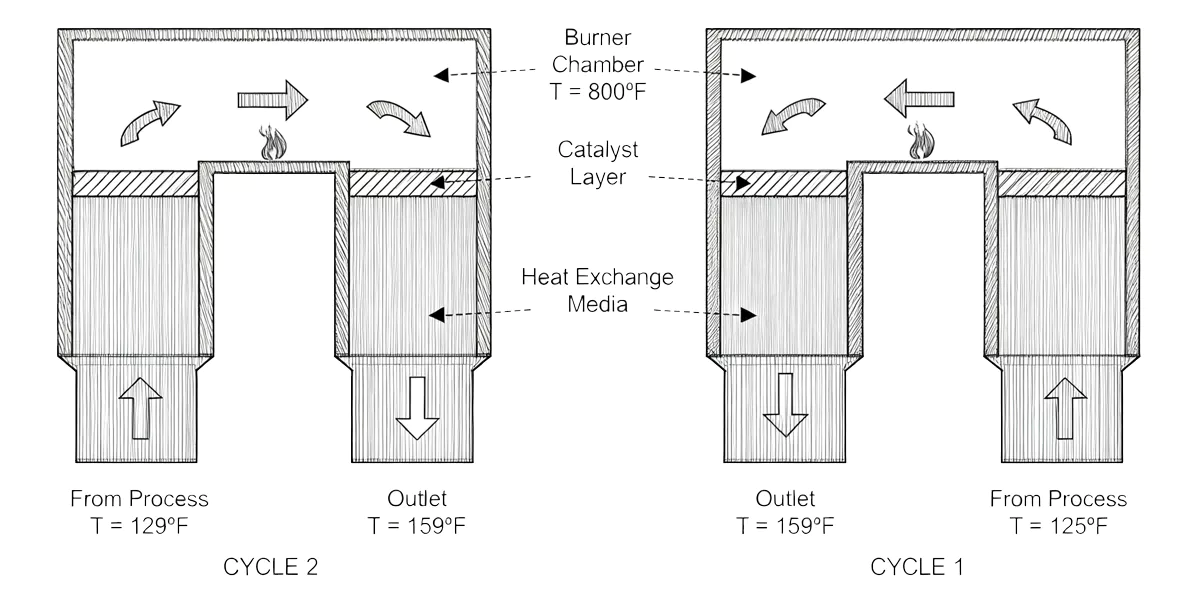
Routine monitoring should preserve the context around odor or emissions reports. Record source area, weather or operating conditions where relevant, flow, process changes, alarms, maintenance events, and sampling results. Avoid treating an odor complaint alone as proof that the RCO catalyst has failed. The cause could be capture, a new source, a wet duct, an instrument issue, or a treatment condition outside the reviewed envelope.
Change control should cover new chemicals, wastewater inputs, chemical dosing, source enclosure changes, fan balancing, and modifications to extraction branches. Before adopting a change, compare it with the original design envelope and determine whether sampling or supplier review is necessary. Keep the review proportionate to the potential effect, but document the decision so the operating team knows which conditions were considered. Before freezing the scope, review RCO process stages with the team responsible for the operating envelope.
Preguntas frecuentes
Does RCO automatically solve wastewater odor?
Is a total VOC test enough for wastewater exhaust?
Why does moisture matter?
Can one sample represent the entire wastewater facility?
What should be defined before procurement?
Prepare source-specific chemistry, wet-stream conditions, flow data, and a clear VOC or odor acceptance basis before choosing the treatment arrangement.
 ES
 EN
 ZH
 AR
 ID
 PT
 FR
 JA
 RU
 DE
 MS
 CS
 BG
 NL
 KO
 RO
 SK
 TH
 VI
 ZH_TW
 UK