
Regenerative Thermal Oxidizer (RTO) for Coil Coating Industry
Target Audience: Plant Managers, EHS Directors, and Operations Leads in Steel/Aluminum Coil Coating Lines (CCL).
Core Promise: Our specialized RTO solutions deliver >99% VOC destruction efficiency while turning your waste gas into a valuable energy asset—slashing oven fuel costs by up to 60%.
1. Industry Background: The Continuous Challenge of Coil Coating
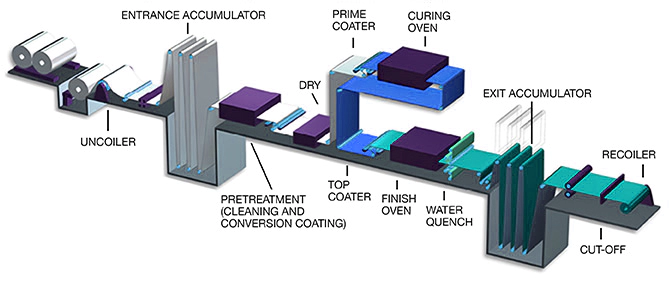
I always tell people, imagine trying to paint a mile-long highway at full sprint; that’s essentially what these coil coating operations are doing—they run on these colossal, continuous processing lines, often zipping along at an incredible $100$ 到 $200$ meters per minute! Whether they’re spitting out that pre-painted metal that ends up as the roof over your head, the shiny skin of your new car, or the pristine façade of your refrigerator, the core activity always involves smoothly applying these liquid coatings onto massive metal strips and then aggressively baking them solid in ovens that look, and cost, like they were designed for a giant’s kitchen.
Now, here’s where my expertise comes in: unlike the stop-and-start nature of batch spray painting—which is child’s play, really—these Coil Coating Lines (CCLs) are like the Energizer Bunny; they just keep going, running a full twenty-four hours a day, seven days a week. This continuous, high-volume operation means we are facing a brutal, two-sided challenge that keeps plant managers up at night: first, we have to comply with those ever-tightening VOC abatement regulations that the government keeps throwing at us; and second, the price of the natural gas required to maintain those oven curing temperatures—we’re talking a consistent $250^\circ\text{C}$ 到 $350^\circ\text{C}$—is just absolutely skyrocketing.
2. Waste Gas Characteristics & Composition Analysis
Designing an RTO for coil coating requires understanding the specific exhaust profile. The emissions primarily come from the 固化爐 (Prime and Finish ovens).
| Process Point | Typical VOC Components | Concentration & Characteristics |
|---|---|---|
| Prime / Finish Oven Exhaust | Isophorone, Xylene, MEK, Glycol Ethers, Aromatic Hydrocarbons (Solvesso) | High Temperature: 250°C – 350°C Medium-High Concentration: 2,000 – 8,000 mg/m³ (Often controlled at < 25% LEL) |
| Coater Room (Ventilation) | Solvent vapors from mixing & application heads | High Volume, Low Concentration: Ambient temperature, needs concentration (Zeolite) or mixing with oven air. |
| Quench / Cooling Zone | Condensable VOCs, Oil mists | High moisture, potential for duct condensation. |
3. Hazards & Urgency of Treatment
Safety: The LEL Risk
those solvents we use in coil coating are not just slightly flammable, they are often highly combustible little time bombs! If you slack off on proper abatement or lose control of the airflow for even a minute, the concentration of those VOCs inside your system can easily climb past the dreaded Lower Explosive Limit (LEL). When that happens, you’re not just dealing with a minor problem; you’re looking at a catastrophic explosion risk that could literally turn your beautiful facility into a very expensive pile of twisted metal.
Environmental & Economic Penalties
we’re talking about seriously nasty stuff, like Isophorone, which the regulators have rightly classified as a hazardous air pollutant, meaning that if you don’t clean it up, the government will happily serve you with heavy fines or, even worse, hand you a forced shutdown notice, completely halting production. And here’s the kicker that makes me groan every time I see it: if you are simply venting all that screaming hot oven exhaust straight out into the atmosphere without bothering to recover the heat, you are quite literally taking crisp hundred-dollar bills and setting them on fire, especially with the way natural gas prices are looking today.
4. Global Regulatory Snapshot
- European Union (IED Directive 2010/75/EU): Coil coating is specifically targeted under Annex VII. Emission limits for Total Organic Carbon (TOC) are often < 50 mg C/m³ (and < 20 mg/m³ where new techniques are applied).
- USA (EPA MACT NNNN): NESHAP for Surface Coating of Large Appliances and Metal Coil. Requires >98% destruction efficiency or specific outlet concentration limits.
- China (GB 37822-2019 & Local DB): “Standard for volatile organic compounds emission control.” Key regions require NMHC < 50 mg/m³ and stringent controls on fugitive emissions from the coater room.
5. How RTO Works: High Energy Efficiency
Ever-Power RTO isn’t just a big furnace; it’s the industry’s undisputed champion for coil coating because of its clever, regenerative design, utilizing that ceramic heat exchange media—it’s essentially a high-tech internal radiator—to snag the heat from the exiting clean air and use it to blast the incoming dirty oven exhaust up to a scorching preheat temperature, usually around 800℃, a move that ensures we completely incinerate those VOCs, transforming them cleanly into harmless CO2 and H2O.
But here’s the real genius, the feature we call the ‘Auto-Thermal’ Advantage: because coil coating exhaust carries a naturally high solvent load—meaning it has a fantastic calorific value—the RTO often gets so much energy from the burning solvents themselves that once the concentration passes a surprisingly low threshold, typically around 1.5 g/m³, the system becomes self-sustaining! This beautiful phenomenon means that during your steady production runs, the RTO uses absolutely zero auxiliary fuel, running entirely on the energy it harvests from the pollutants you were trying to get rid of anyway.It’s like getting free gasoline from your own trash
6. RTO vs. Other Technologies
| 科技 | Pros | Cons for Coil Coating | Verdict |
|---|---|---|---|
| RTO (Regenerative) | High Thermal Efficiency (95%), Best Heat Recovery potential. | Requires careful pressure control integration. | ★ Preferred |
| Direct Fired Thermal Oxidizer (TO/Incinerator) | Simple, handles very high LELs. | Huge Fuel Consumption. Only viable if 100% heat is recycled to oven immediately. | Outdated |
| 催化氧化劑(CO) | Lower operating temp. | Catalyst poisoning risk from metal substrates/additives; High replacement cost. | Risky |
7. Our Exclusive RTO Design: Optimized for Coil Coating
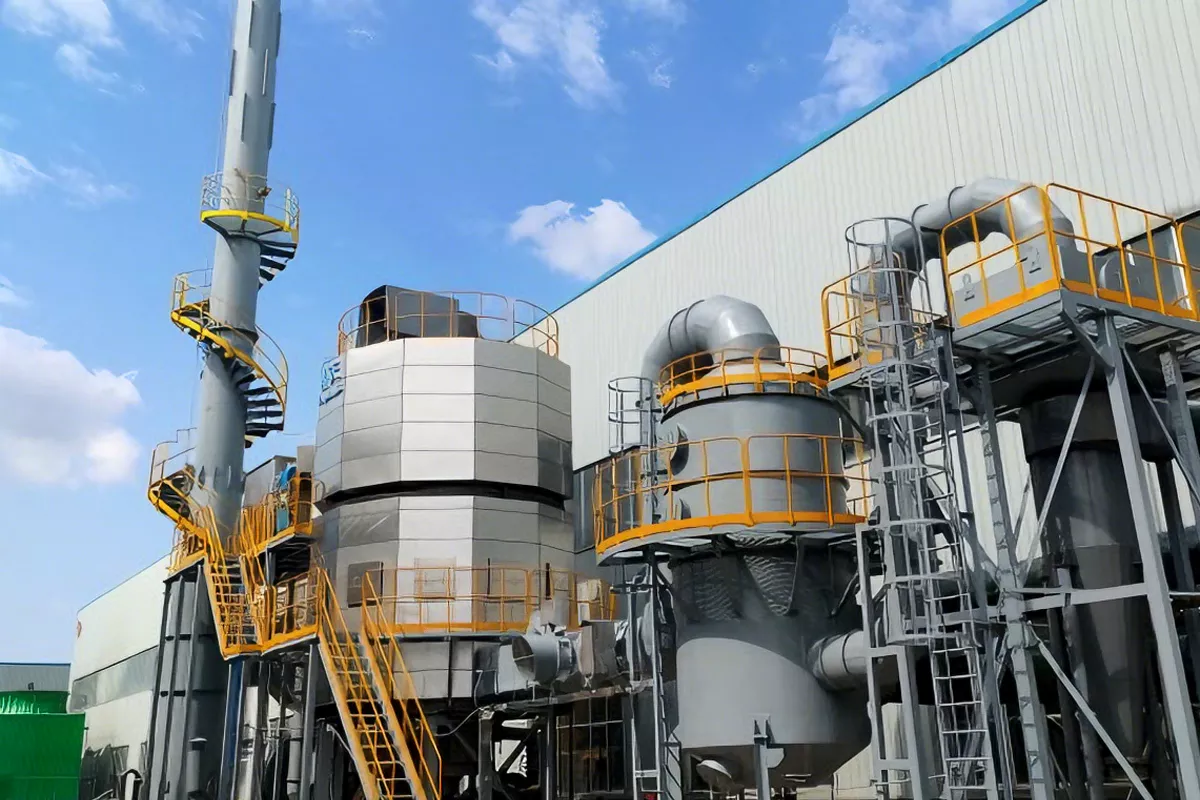
We don’t just sell a box; we sell an Energy Center. Our design addresses the specific needs of high-speed coil lines:
1. Secondary Heat Recovery (WHR)
The Game Changer: We install a secondary Heat Exchanger (Air-to-Air) at the RTO outlet. The clean, hot air (approx. 200°C-300°C) is piped directly back to the curing oven intake.
Result: The RTO acts as the primary burner for your oven, reducing natural gas usage by up to 60%.
2. High-LEL Hot Bypass
Safety First: Coil coating exhaust can sometimes become “too rich” (too much solvent). Our system includes a Hot Bypass that automatically vents excess heat directly to the stack (or recovery boiler) to prevent RTO overheating while maintaining combustion chamber stability.
3. Negative Pressure Control
品質保證: Fluctuations in RTO pressure can disturb the oven airflow, causing “strip flutter” or uneven curing. Our VFD logic ensures a perfectly stable negative pressure at the oven outlet.
8. ROI & Operational Cost Optimization
The Profit Model
ROI = (Oven Fuel Savings + Fines Avoided) / Initial Investment
By integrating 廢熱回收, the RTO effectively replaces your oven burners.
Typical Payback Period for a high-speed line: 18 to 24 months.
This turns an environmental expense into a profitability upgrade.
9. Success Stories: Concrete Results
Case 1: Appliance Panel Manufacturer (China, Guangdong)
客戶: Leading supplier of pre-painted steel for refrigerators (White Goods).
Challenge: Old direct-fired incinerator was consuming $800k USD/year in natural gas. VOC emissions were unstable during color changeovers.
Our Solution: Replaced with a 3-Bed RTO (45,000 Nm³/h) + Multi-pass Heat Exchanger.
Result:
✅ Destruction Efficiency: >99.5% (Meeting GB 37822)
✅ 節省成本: Recovered heat now provides 100% of the thermal energy required for the Finish Oven. Gas bill dropped by 70%.

Case 2: Aluminium Roofing Coil Producer (Germany)
客戶: Manufacturer of architectural aluminium coils.
Challenge: Strict EU limits (<20 mg/m³) and a need for carbon neutrality (Decarbonization).
Our Solution: Rotary RTO coupled with a Thermal Oil Heat Recovery system.
Result:
✅ 可持續性: The system runs auto-thermally. Excess heat generates hot oil used for plant space heating in winter.
✅ Uptime: 99.9% availability over 2 years, ensuring zero line stoppages.
Case 3: Automotive Steel Coil Line (Mexico)
客戶: Tier 1 supplier for North American auto plants.
Challenge: High LEL concentrations posed an explosion risk; fluctuating air volumes caused oven pressure issues.
Our Solution: RTO with advanced LEL Control Loop and Fast-Response VFDs.
Result:
✅ 安全: Automated dilution air ensures LEL never exceeds 25%.
✅ 品質: Stable oven pressure improved coating uniformity (film thickness) by 15%.
10. Frequently Asked Questions (FAQ)
Q1: Can the RTO replace my oven burner completely?
A: In many cases, yes. If the solvent load is high enough, the secondary heat recovery can provide all necessary heat for the oven zones, relegating the oven burners to “pilot only” mode.
Q2: What happens if the line stops (Emergency Stop)?
A: Our RTO enters an “Idle Mode” or “Hot Standby.” It recirculates its own air to maintain temperature with minimal fuel, ready to ramp up immediately when the line restarts.
Q3: How do you handle condensables (tar) from the cooling zone?
A: We recommend a pre-filtration unit or a specialized “bake-out” feature in the RTO ceramic bed to periodically remove organic buildup, preventing fires and blockages.
Q4: Is a 2-Bed or 3-Bed RTO better for Coil Coating?
A: For most applications, a 3-Bed RTO is preferred to minimize the “puff” of untreated gas during valve switching, ensuring >99% destruction efficiency at all times.
 ZH_TW
ZH_TW  EN
EN  ZH
ZH  ES
ES  AR
AR  ID
ID  PT
PT  FR
FR  JA
JA  RU
RU  DE
DE  MS
MS  CS
CS  BG
BG  NL
NL  KO
KO  RO
RO  SK
SK  TH
TH  VI
VI  UK
UK