Quick answer: An RTO recovers heat by alternately heating and cooling regenerative media, usually ceramic, as exhaust flow is switched through the beds. Buyers should evaluate the operating envelope, media condition, airflow, switching arrangement, and monitoring plan together rather than treating heat recovery as a stand-alone percentage.
RTO heat recovery is valuable because it moves energy from the treated hot gas back into the incoming process exhaust, reducing the amount of supplemental heat the burner must provide after stable operation is reached. The important purchasing question is not a single advertised percentage. It is whether the heat-recovery arrangement still fits the real airflow, VOC profile, temperature, contaminants, operating schedule, and pressure-drop limits of the process.
The site already has a general explanation of how a regenerative thermal oxidizer works, so this guide focuses on a narrower buyer job: how to review the heat-recovery side of a proposal without confusing a laboratory efficiency figure with guaranteed plant performance. That distinction matters when production changes, clean-air dilution varies, or the ceramic beds slowly accumulate material.
Ceramic regenerative media is central to heat storage and transfer in an RTO.
Inlet exhaust temperature and the wider decision
Inlet exhaust temperature. A warmer incoming stream starts closer to the oxidation temperature than a cold stream, while a colder stream asks the regenerative beds and burner to supply a larger temperature rise. The same RTO can therefore show different auxiliary-fuel demand across seasons, production modes, or upstream dryer settings. In a specification review, record the expected minimum, normal, and maximum inlet temperatures rather than giving one nominal value.
VOC concentration and heating value. Organic compounds in the exhaust release heat when oxidized, so a richer VOC stream can reduce auxiliary fuel once the system is stable. A leaner stream may need more burner input even when the hardware has not changed. The compound mixture also matters because not every VOC behaves identically. In a specification review, provide a representative concentration range and compound list, including low-load and upset conditions.
Airflow range. Heat recovery is tied to gas mass flow and bed velocity. A system that spends most of its time far below or above the design airflow can behave differently from the headline design point, affecting pressure drop, residence time, valve timing, fan duty, and fuel use. In a specification review, show the actual operating airflow range by production mode instead of sizing from peak flow alone.
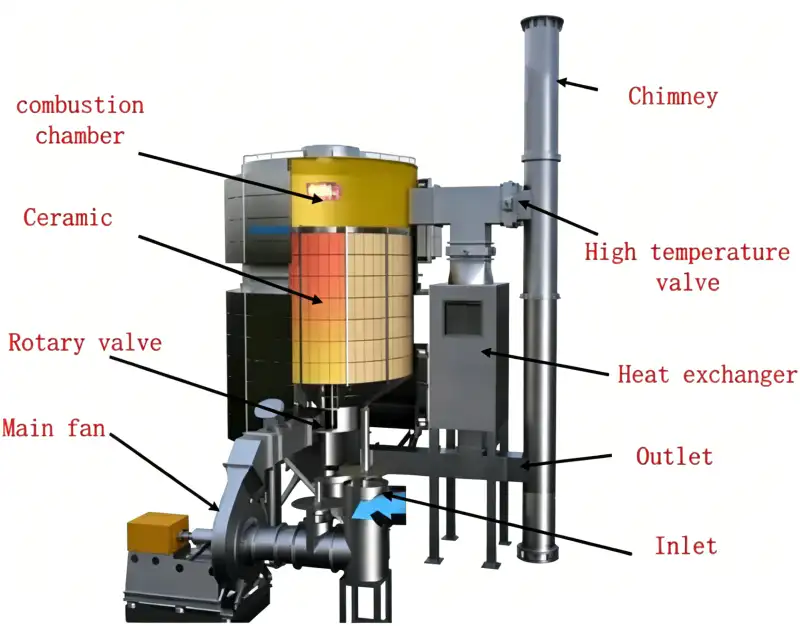
A combustion-principle image helps connect recovered heat with the oxidation step.
Ceramic media condition. Regenerative media needs open flow paths and usable heat-transfer surface. Dust, sticky condensables, salts, corrosion products, or physical settling can change both resistance and thermal behavior. A rising pressure trend is evidence to investigate, not automatic proof that every block must be replaced. In a specification review, compare current differential-pressure and fuel trends with a clean or commissioned baseline before defining the maintenance scope.
Switching strategy. Bed switching controls which media receives hot treated gas and which media preheats incoming exhaust. Timing, valve condition, purge logic, leakage, and the number of chambers can influence both energy performance and emission stability. These details are system-specific and should not be reduced to a universal cycle time. In a specification review, ask how the supplier validates switching under minimum, normal, and maximum flow.
Air leakage and dilution. Unwanted ambient air entering ducts, dampers, doors, expansion joints, or capture points increases the amount of gas that must be heated without adding useful VOC heat. Intentional dilution can also be necessary for process or safety reasons, but it should be included in the heat balance. In a specification review, separate required dilution from avoidable leakage and quantify both in the design basis.
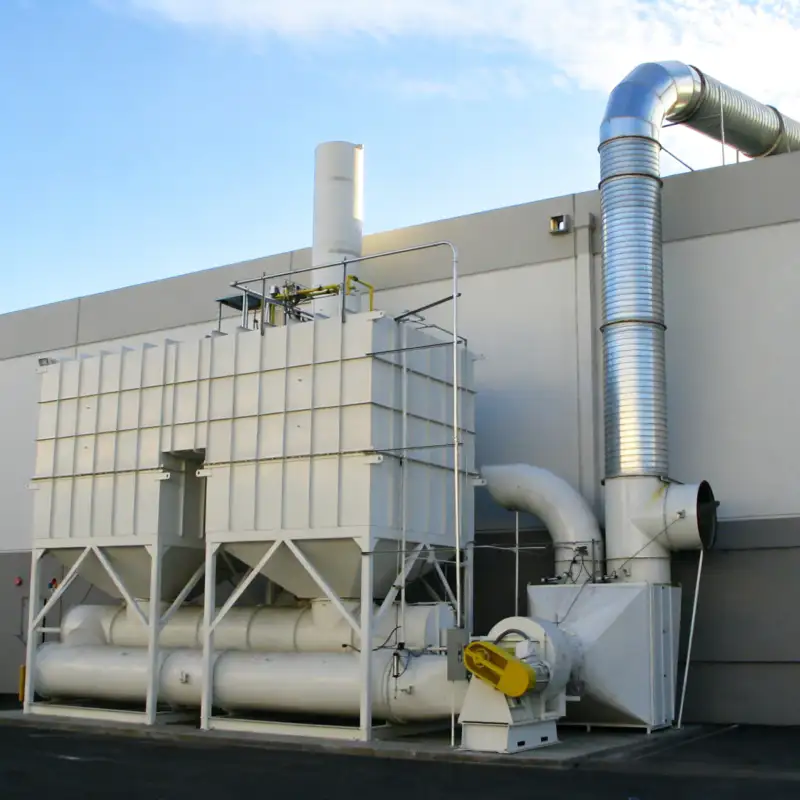
Bed RTO architecture uses regenerative chambers that alternately store and release heat.
Pressure drop and fan load. A heat-recovery bed is also a flow resistance. When resistance rises, the fan operating point changes and electrical demand may increase. If flow is not maintained, process capture and oxidation conditions can be affected. Pressure drop therefore belongs in both the energy and maintenance discussion. In a specification review, request clean and fouled design cases together with the planned differential-pressure monitoring locations.
Production schedule. An RTO that runs continuously has a different startup and cool-down pattern from equipment that starts for short campaigns. Repeated warm-up periods can dominate fuel consumption for intermittent lines even if steady-state heat recovery is strong. In a specification review, include shift pattern, weekend shutdowns, cleaning cycles, and expected idle periods in the operating profile.
Heat reuse outside the RTO. Recovered energy can sometimes support upstream or plant heat needs, but only after temperature level, cleanliness, control philosophy, and process demand are confirmed. A heat-reuse idea should not be counted twice in the energy case or treated as free energy. In a specification review, ask for a separate heat-reuse balance with clearly stated assumptions and boundaries.
Monitoring evidence. Combustion-chamber temperature, exhaust flow, outlet VOC, fan current, oxygen or carbon dioxide, fuel pressure, and relevant differential pressures can help explain whether energy or treatment performance is drifting. The exact instruments depend on the installed design and permit. In a specification review, define which trends will be stored and who will review them after commissioning.
How to review a heat-recovery claim without chasing one number
1. Build a process envelope
Collect minimum, typical, and maximum airflow, temperature, VOC concentration, oxygen, moisture, particulate or aerosol content, and production schedule. A heat balance based on only the best operating point is not a durable purchasing basis.
2. Ask for the energy balance by operating case
Have the proposal distinguish warm-up, low-VOC, typical production, high-load, and planned shutdown states. The calculation should show what changes the burner demand rather than hiding those changes inside one average figure.
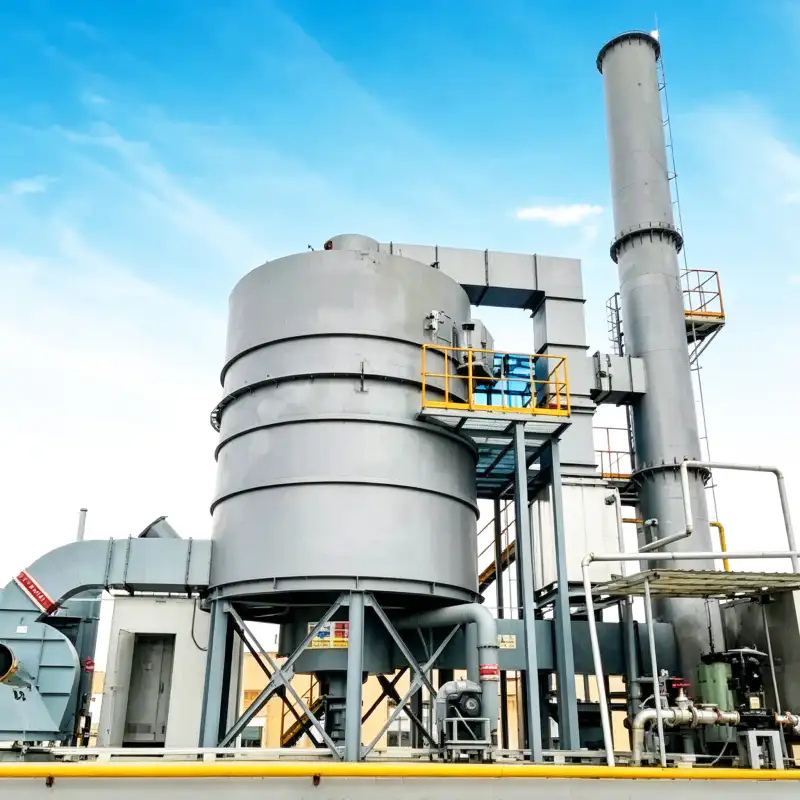
Rotary RTO architecture uses a different flow-switching arrangement while preserving regenerative heat recovery.
3. Connect pressure drop to energy use
Review clean-bed pressure drop, expected operating range, fan duty, and the method for trending bed restriction. This is where maintenance data becomes part of the energy conversation.
4. Define what will be proven after startup
Agree on which logged parameters, inspections, and emission checks will be used to confirm that the installed system matches the approved design basis. Keep regulatory acceptance criteria separate from marketing language.
Heat-recovery review checklist for an RTO proposal
Airflow: minimum, typical, maximum, and short-term upset values.
Inlet gas temperature for every important production mode.
VOC species and concentration range, with the sampling basis identified.
Oxygen, humidity, particulate, aerosol, and condensable content that may affect media.
Expected clean-bed pressure drop and the planned differential-pressure monitoring points.
Burner fuel type and how warm-up, low-load, and steady operation are represented in the heat balance.
Valve or rotary switching concept and how leakage or purge flow is addressed.
Production calendar, shutdown frequency, and cleaning or changeover periods.
Any proposed secondary heat-reuse duty shown as a separate, reviewable calculation.
Commissioning evidence and trend data that will be retained for future comparison.
Structural views help buyers identify where flow, switching, media, and combustion sections interact.
Questions buyers commonly ask
Does a higher heat-recovery percentage always mean lower operating cost?
No. A design percentage describes one part of the energy picture. Actual cost also depends on airflow, VOC heat release, inlet temperature, fuel price, fan power, pressure drop, production schedule, leakage, and maintenance condition. Compare complete operating cases rather than a single efficiency label.
Can ceramic media performance decline without a dramatic failure?
Yes. Deposits, settling, damaged channels, flow maldistribution, or upstream process changes can shift pressure drop and thermal behavior gradually. Trending is more informative than waiting for one alarm. The appropriate inspection or cleaning method must follow the installed design and site safety procedure.
Why can fuel use increase after a production change?
A new product may change solvent loading, dryer exhaust temperature, capture airflow, or intentional dilution. Any of those changes can alter the heat balance even when the RTO hardware is healthy. Compare current process conditions with the design basis before assuming the burner or media is faulty.
What internal pages should I review before requesting a quote?
Start with the site overview of what an RTO is, then compare the bed RTO and rotary RTO pages because architecture affects switching, pressure drop, maintenance access, and the way heat is regenerated. Use the contact page after your process envelope is ready.
A practical next step
Heat recovery works best as an engineering balance, not as a slogan. Put the real process envelope beside the proposal, ask how the ceramic beds, switching arrangement, fan, burner, and controls behave across that envelope, and define what operating evidence will be retained after startup. That approach gives procurement a defensible comparison and gives the maintenance team a useful baseline for the years that follow.
Prepare the process facts before asking for a final configuration.
Use the site resources above to compare equipment concepts, then send the operating envelope and project constraints through the verified contact page.



 CS
 EN
 ZH
 ES
 AR
 ID
 PT
 FR
 JA
 RU
 DE
 MS
 BG
 NL
 KO
 RO
 SK
 TH
 VI
 ZH_TW
 UK