
Popis
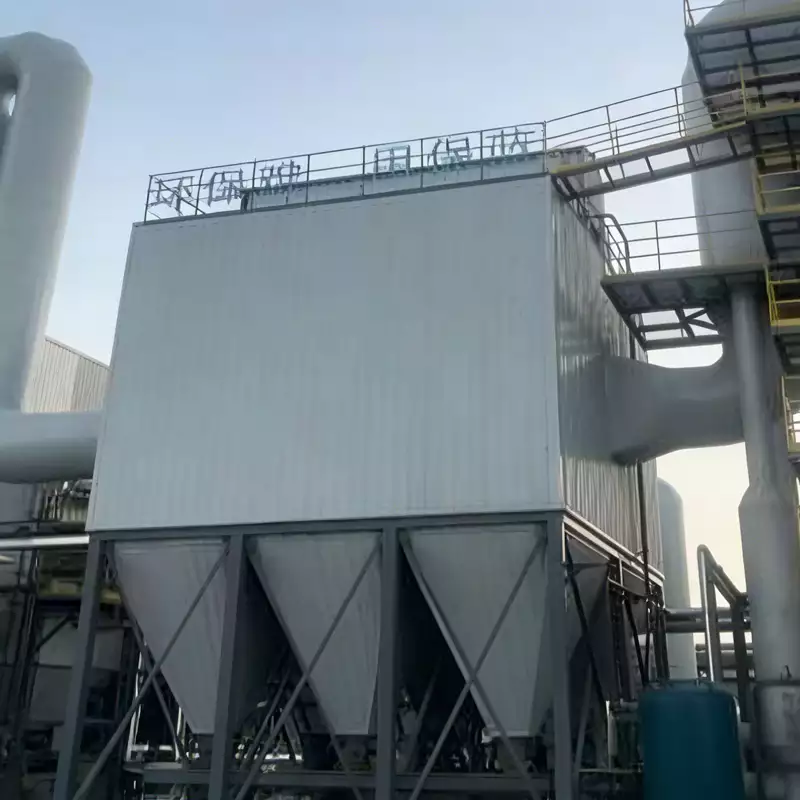
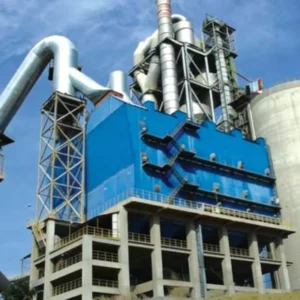
Industrial Particulate Filtration | BLBD1W/230W Series Bag Dust Collector
Eradicate Unplanned Downtime, Mitigate Compliance Risks, and Slash Total Cost of Ownership (TCO) with Next-Generation Operational Efficiency.
2. Executive Brief: Financial & Operational Metrics
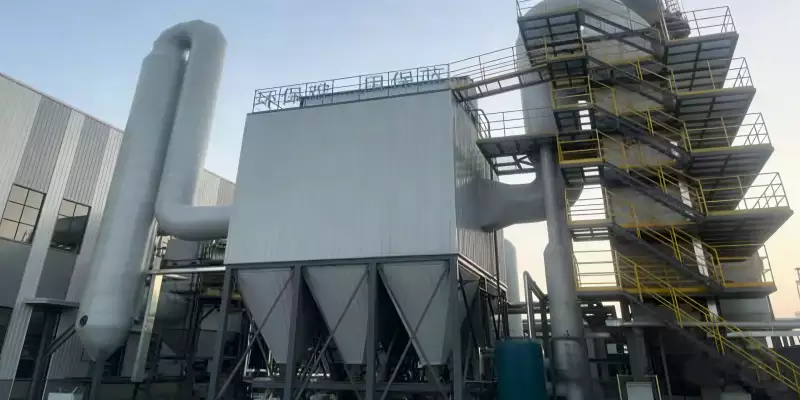
For the modern industrial facility, filtration is not merely an environmental obligation; it is a critical variable in the operational expenditure (OPEX) equation. The BLBD1W/230W Series is engineered specifically for procurement directors and plant managers who demand measurable returns on capital expenditure (CAPEX).
Efficiency Yield
99.99%
Particulate capture rate, ensuring absolute regulatory compliance and zero penalty risks.
Energy Optimization
-25%
Reduction in compressed air consumption for pulse-jet cleaning compared to legacy systems.
Asset Longevity
+40%
Extension in filter bag lifecycle, drastically reducing annualized maintenance outlays.
Average Payback
14-18 Months
Rapid ROI through recovered product, minimized downtime, and lowered utility bills.
3. Deep Technical Analysis: BLBD1W/230W Parameters
To calculate precise integration costs, engineers require uncompromised data. The following matrix outlines the rigorous performance parameters of the BLBD1W/230W series. These metrics are the foundation of our predictable cost-of-ownership models.
| Model Specification | Airflow Volume (m3/h) | Filtration Area (m2) | Filtration Velocity (m/min) | Number of Filter Bags | Equipment Resistance (Pa) | Motor Power Matrix (kW) |
|---|---|---|---|---|---|---|
| BLBD1W-100 | 15,000 – 22,000 | 350 | 0.8 – 1.2 | 240 | Less than 1200 | 18.5 |
| BLBD1W-150 | 25,000 – 35,000 | 520 | 0.8 – 1.2 | 360 | Less than 1200 | 22.0 |
| BLBD1W-200 | 38,000 – 50,000 | 750 | 0.8 – 1.2 | 520 | Less than 1500 | 37.0 |
| BLBD230W-Ultra | 55,000 – 75,000 | 980 | 0.8 – 1.2 | 720 | Less than 1500 | 55.0 |
* Note: Custom configurations available based on detailed dust concentration, gas temperature, and specific gravity metrics. Contact our engineering team for a customized pressure-drop analysis.
4. Process Principles & Core Structural Economics
Understanding the physics of the BLBD1W/230W is crucial to understanding its financial advantages. Every structural decision was driven by the necessity to lower the Total Cost of Ownership.
The Physics of Filtration (Working Principle)
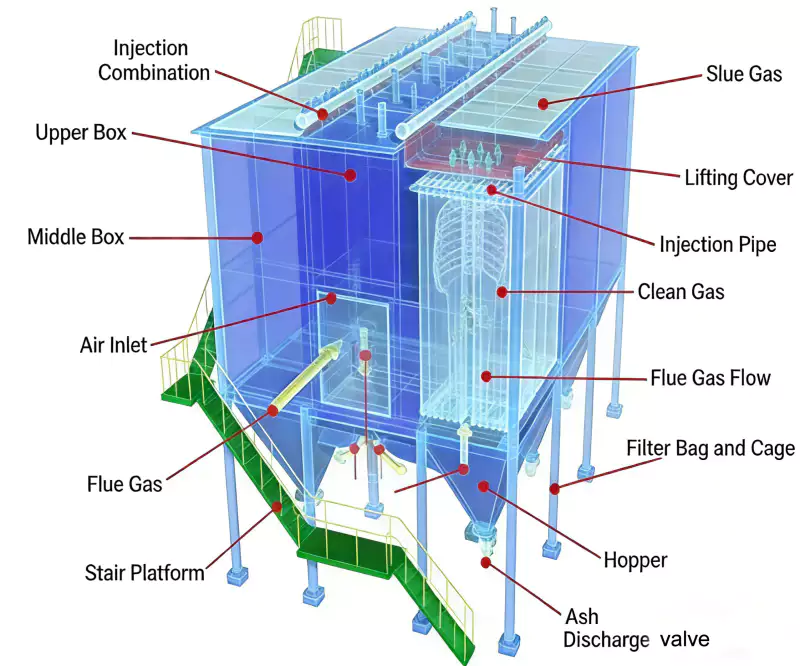
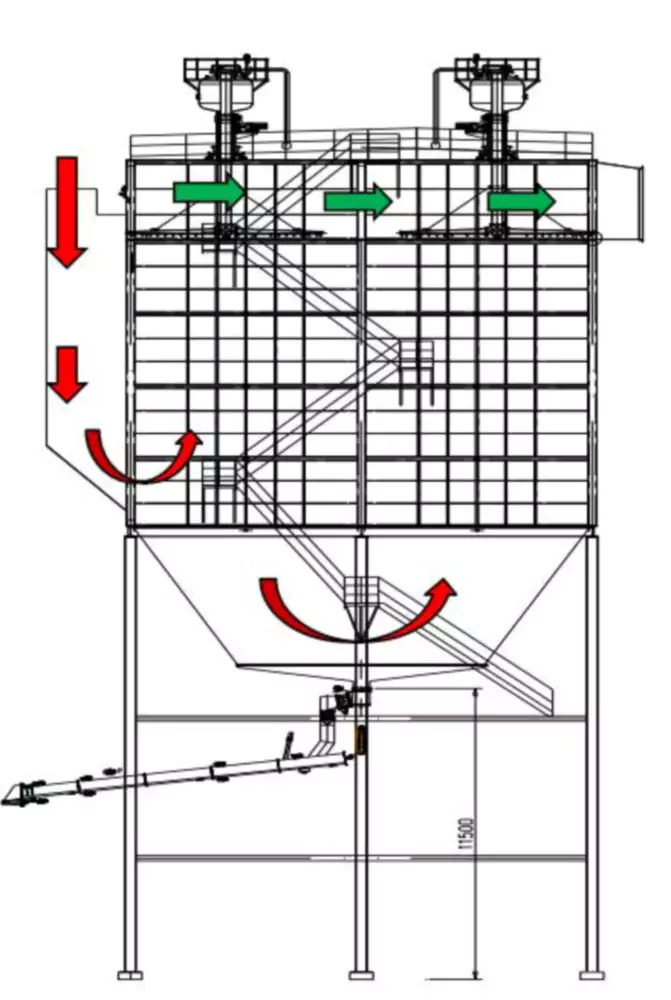
Dust-laden gas enters the middle and lower box of the collector via the intelligently designed inlet duct. Due to a calculated expansion in cross-sectional area and the installation of a baffle plate, the dynamic pressure drops rapidly. Coarse particles, governed by gravity and inertia, fall directly into the ash hopper—bypassing the filter bags entirely. This preliminary separation is an OPEX multiplier, as it drastically reduces the abrasion on the primary filter media, thereby extending bag life and delaying replacement capital cycles.
The finer particulate matter is then drawn upward into the filtration chamber. As the gas permeates the outer surface of the filter bag, dust is trapped. The purified gas enters the upper box and is exhausted. The differential pressure across the bags is continuously monitored by a high-precision sensor suite.
Intelligent Pulse-Jet Cleaning (Internal Structure)
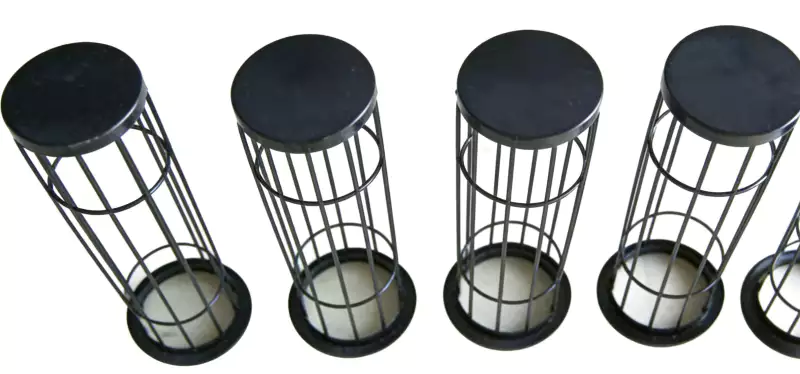
When resistance reaches the pre-programmed economic set-point (typically 1200 Pa), the PLC triggers the pulse valve. High-pressure compressed air (0.5-0.7 MPa) is injected through a proprietary Venturi tube, inducing secondary air at several times the volume of the primary air into the bag. This creates an instantaneous positive pressure wave, shaking off the dust cake into the hopper. This precise algorithmic triggering prevents over-cleaning (which destroys bag fibers) and under-cleaning (which spikes fan energy consumption).
5. Design Features & OPEX Advantages
- ✔Computational Fluid Dynamics (CFD) Optimized Gas Distribution:
Uneven gas flow leads to premature localized bag failure. Our CFD-modeled baffles ensure 100% uniform flow distribution, maximizing the utilization rate of every square meter of filter media. Financial Impact: Extends media lifecycle by up to 1.5 years. - ✔Zero-Leakage Structural Welding:
Constructed with a continuous seam welding process under strict ISO quality control, ensuring an equipment air leakage rate of less than 2%. Financial Impact: Prevents energy waste from induced draft fans pulling false air, saving thousands in annual electricity costs. - ✔Advanced PLC Automated Control System:
Real-time monitoring of pressure drop, temperature, and emission levels. Capable of remote SCADA integration. Financial Impact: Eliminates the need for constant manual monitoring, reducing labor overhead and preventing catastrophic thermal damage to bags.
6. The Cost of Inaction: Why Efficient Dust Collection is a Financial Imperative
Treating industrial dust collection as an afterthought is a calculable financial error. The global push for carbon neutrality and stringent environmental policies (such as the EU’s Industrial Emissions Directive and stringent local EPA equivalents) means non-compliance carries severe fiscal penalties. However, regulatory fines are only the visible fraction of the cost.
1. Accelerated Equipment Depreciation
Abrasive airborne particulates infiltrate moving parts, bearings, and control boards. Sub-standard filtration accelerates machinery wear by up to 35%, forcing premature capital replacement.
2. Product Contamination Losses
In cement, chemical, and food processing, cross-contamination via settling dust reduces overall product yield. An inefficient dust collector directly reduces saleable output.
3. Unplanned Operational Downtime
When an inferior dust collector clogs or fails, the entire production line must halt. If your facility’s downtime costs $10,000 per hour, a cheap dust collector becomes the most expensive asset in your plant.
7. Typical Application Scenarios & Industry Adaptability
The BLBD1W/230W is not a general-purpose box; it is an engineered solution tailored for high-stakes industrial environments where uptime is paramount.
| Sector | Target Application | Financial & Operational Value Add |
|---|---|---|
| Metallurgy & Steel | Electric Arc Furnaces (EAF), Sintering Plants, Blast Furnace cast houses. | Handles extreme temperature fluctuations and heavy abrasive loads, capturing valuable heavy metal dust for reprocessing. |
| Cement & Building Materials | Kiln head/tail, clinker coolers, raw mills, packing plants. | High volume, continuous load management. Recovers tons of usable raw material per day, directly injecting value back into the supply chain. |
| Power Generation | Coal-fired boilers, biomass energy generation fly ash control. | Ensures continuous base-load operation without forced outages due to emission exceedance. Handles fine, sticky fly ash efficiently. |
| Chemical Processing | Dryers, granulation processes, material handling and transport. | Provides anti-static and explosion-proof configurations to protect multi-million dollar plant assets from combustible dust hazards. |
8. Comparative ROI: BLBD1W/230W Series vs. Traditional Solutions
Procurement must evaluate beyond the initial sticker price. Below is a 5-year Total Cost of Ownership (TCO) comparison based on a standard 50,000 m3/h capacity application.
| Cost Category (5-Year Cycle) | Traditional Dust Collector | BLBD1W/230W Series | Financial Impact |
|---|---|---|---|
| Initial CAPEX | Baseline ($) | Baseline + 15% | Higher Initial Outlay |
| Energy Cost (Fan & Compressor) | High (Inefficient flow, high resistance) | Low (CFD optimized, smart pulsing) | -25% Annual OPEX |
| Consumables (Filter Bag Replacement) | Replaced 4 times | Replaced 2 times | -50% Material & Labor |
| Unplanned Downtime Cost | Avg 48 hours/year | Less than 8 hours/year | 83% Reduction in Lost Yield |
| 5-Year Total Cost of Ownership (TCO) | 100% (Index) | 68% (Index) | Net Savings: 32% over 5 Years |
9. Strategic Partnership: Why Choose Us?
Procuring heavy environmental equipment is a strategic partnership, not a transactional purchase. We offer a vertically integrated service model designed to mitigate all project risks.
- Autonomous R&D and Manufacturing: The BL series is entirely proprietary. We control the supply chain from raw sheet metal to final PLC coding. This eliminates middleman markups and guarantees stringent quality control.
- End-to-End Capability: We provide comprehensive Engineering Design + Lean Manufacturing + Intelligent Commissioning. You deal with a single point of accountability.
- Proven Corporate Pedigree: Trusted by industry titans. We have successfully executed massive filtration installations for leading conglomerates, including Tongchuan Shengwei, Shanshui Group, and China Resources Power, securing their operational continuity.
- Certified Reliability: Full compliance with ISO 9001, ISO 14001, and extensive international environmental certifications. Your investment is protected by documented quality frameworks.
10. Engineering Data Requisition: Selection Guide
To provide a guaranteed performance metric and a binding financial quote, our engineering team requires accurate operational data. Avoid estimation errors by preparing the following parameters for our technical dialogue:
- Actual Processing Gas Volume (m³/h): Provide both standard and peak flow rates.
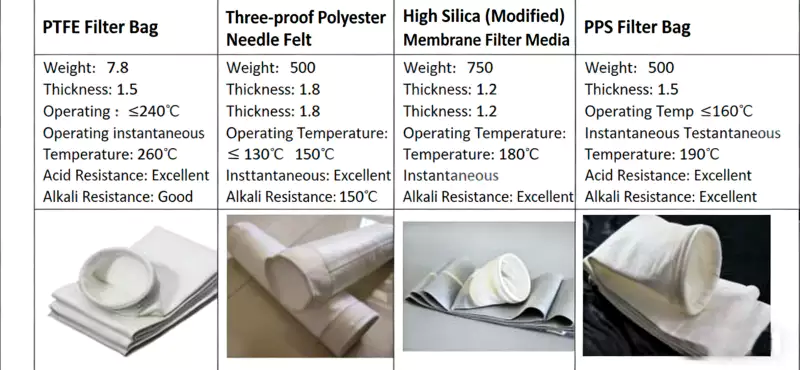
- Gas Temperature Profile (°C): Normal operating temperature, peak temperature, and dew point. This dictates filter media selection (e.g., PTFE, PPS, Nomex).
- Dust Characteristics: Chemical composition, bulk density, abrasiveness, moisture content, and particle size distribution (micron rating).
- Inlet Dust Concentration (g/Nm³): Critical for sizing the hopper and pulsing frequency.
- Required Emission Standard (mg/Nm³): Local regulatory limit you must legally achieve.
- Site Constraints: Footprint dimensions, indoor/outdoor placement, and altitude (for fan static pressure calculations).
11. Value Quantification: The ROI Mathematics
Let’s calculate the true financial impact. Consider a mid-sized steel plant operating 8,000 hours annually, facing frequent baghouse blinding with a legacy system.
The ROI Equation:
Net Annual Savings = (Avoided Downtime Hours × Hourly Profit Yield) + (Energy Savings kW × Grid Cost) + (Deferred Maintenance Capital)
- Avoided Downtime: Upgrading to the BLBD1W saves an estimated 40 hours of unplanned downtime. At $5,000/hour facility yield, savings = $200,000/year.
- Energy Efficiency: Reduced pressure drop saves 25kW continuously. Over 8,000 hours at $0.12/kWh, savings = $24,000/year.
- Maintenance Deferral: Extending bag life from 12 to 24 months cuts material and labor by half, yielding roughly $15,000/year in savings.
Total Annualized Cash Flow Recaptured: $239,000. Investment payback typically occurs in less than 1.5 years.
12. Global Customer Cases: Proven Profitability Protection
Our units do not just filter dust; they protect financial targets worldwide. Here are verified operational successes:
🇺🇸 Heavy Steel Smelting Facility (Ohio, USA)
Application: EAF Primary Dust Extraction (Model BLBD1W-200)
Outcome: Replaced an aging electrostatic precipitator (ESP) that was incurring massive EPA non-compliance fines. Achieved continuous emission rates below 5 mg/Nm³. Facility management reported a 98% reduction in environmental citation risks and recovered 12% more scrap dust for recycling.
🇩🇪 Specialty Chemical Plant (North Rhine-Westphalia, Germany)
Application: Titanium Dioxide Drying Line (Model BLBD1W-100, Explosion-Proof Config)
Outcome: Plant required absolute zero-cross contamination. The BLBD series integrated flawlessly with their automated SCADA system. Maintenance managers verified a TCO reduction of 22% over three years due to extended PTFE bag longevity under corrosive conditions.
🇻🇳 Cement Clinker Production (Quang Ninh, Vietnam)
Application: Kiln Tail Gas Filtration (Model BLBD230W-Ultra)
Outcome: Handled extreme dust loading volumes in high humidity. By stabilizing the kiln draft pressure, the plant achieved a 3% increase in daily clinker production output, paying for the entire dust collection system in just 14 months.
🇦🇺 Bulk Material Port Terminal (Pilbara, Australia)
Application: Iron Ore Conveyor Transfer Stations (Multiple BLBD1W-150 Units)
Outcome: Severe abrasive wear previously required bag changes every 6 months. Our CFD-optimized inlet baffle design reduced direct particulate impact on the bags, extending replacement cycles to 20 months and drastically reducing confined-space maintenance labor.
13. Operational FAQ: Cost, Installation & Lifespan
How does the BLBD1W compare to Electrostatic Precipitators (ESP) in terms of OPEX?
What is the realistic lifespan of the filter bags?
Can this system handle high-temperature gas streams?
How disruptive is the installation process to our ongoing operations?
What maintenance is required to ensure the stated ROI?
14. Integrated Environmental Strategies: Related Products
Particulate filtration is often just one phase of a complete environmental compliance strategy. For facilities dealing with complex exhaust streams containing both dust and Volatile Organic Compounds (VOCs), a multi-stage approach is financially and technically optimal.
We highly recommend integrating the BLBD1W/230W Series with our comprehensive VOC Treatment Systems. Proper upstream dust removal is absolutely critical to protect the expensive ceramic beds and catalysts in downstream thermal oxidizers.
Stop Subsidizing Inefficiency. Demand Operational Excellence.
Every day your facility operates with an inefficient dust collection system, you are bleeding capital through energy waste, product loss, and accelerated equipment depreciation. Transition to a system designed around Total Cost of Ownership.
Request Your Custom Engineering & ROI Proposal Now
Our engineers will analyze your gas volume, temperature, and emission targets to provide a binding cost-of-ownership projection.
 CS
CS  EN
EN  ZH
ZH  ES
ES  AR
AR  ID
ID  PT
PT  FR
FR  JA
JA  RU
RU  DE
DE  MS
MS  BG
BG  NL
NL  KO
KO  RO
RO  SK
SK  TH
TH  VI
VI  ZH_TW
ZH_TW  UK
UK