
描述
Zeolite Adsorption-Desorption Catalytic Combustion
Stop bleeding operational budget on heating massive volumes of cold, dilute exhaust air. Engineered by Ever-power, the Zeolite Adsorption-Desorption Catalytic Combustion system concentrates volatile organic compounds (VOCs) before destruction. Eliminate activated carbon replacement costs, achieve ≥ 95% overall purification efficiency, and utilize internal waste heat for self-sustaining desorption.
⚙️ Executive Engineering Brief
? Target Gas Profile
- ? Air Volume: Large (10,000 to 200,000+ Nm3/h)
- ?️ VOC濃度: Low (Typically < 1000 mg/Nm3)
- ? Applicable VOCs: Benzenes, Esters, Alcohols, Aldehydes, Ethers, Alkanes
? System Performance
- ✅ Overall Purification: ≥ 95%
- ✅ Catalytic Temp: 250°C – 300°C (Energy Saving)
- ✅ Concentration Ratio: Up to 10:1 to 20:1
- ✅ Empty Tower Velocity: 0.8 – 1.5 m/s
?️ Zeolite Media Specs
- ⚙️ Structure: Honeycomb Zeolite Molecular Sieve
- ? Specific Surface Area: 300 – 1000 m2/g
- ? 安全: Non-flammable, High thermal stability
- ?️ Desorption Energy: ~1/20 of Direct Catalytic
? Technical Parameters
The Ever-power Zeolite Adsorption & Catalytic Combustion system integrates advanced dry filtration, molecular sieving, and low-temperature oxidation into a seamless, automated process.
| Component / Parameter | Specification Range | Engineering Impact |
|---|---|---|
| Primary Dry Filter (G4) | Particle Size > 5μm | Resistance ≤ 50 Pa | Removes coarse dust and paint droplets, preventing premature blinding of the Zeolite pores. |
| Fine Dry Filter (H10) | Particle Size ≥ 0.5μm | 99.9% Efficiency | Ensures ultra-clean gas enters the adsorption box, maximizing the service life of the molecular sieve. |
| Adsorption Wind Speed | 0.8 – 1.5 m/s | Optimized empty tower velocity ensures adequate residence time for shape-selective and polar adsorption. |
| Zeolite Desorption Medium | Hot Air (from CO waste heat) | Drastically reduces OPEX. Desorption requires no external energy source during steady-state operation. |
| Catalytic Ignition Temp | 250°C – 300°C | Precious metal catalysts lower activation energy, destroying concentrated VOCs with minimal burner assistance. |
? Zeolite Adsorption Catalytic Combustion Process
In industries such as printing, coating, and electronics manufacturing, treating low-concentration Volatile Organic Compounds (VOCs) at massive air volumes is a profound engineering challenge. Traditional single technologies fail here: Direct Thermal Oxidation (TO/RTO) burns exorbitant amounts of auxiliary fuel to heat empty air, while traditional Activated Carbon adsorption poses severe fire risks and high secondary disposal costs.
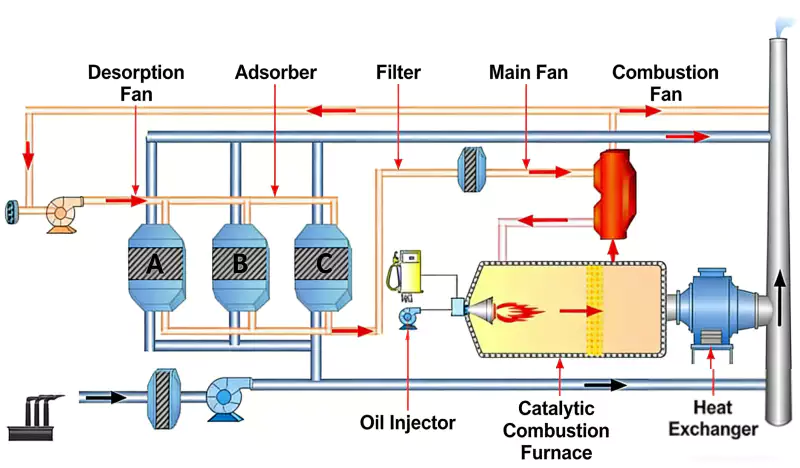
The Ever-power Zeolite Adsorption-Desorption + Catalytic Combustion (CO) combination process solves this bottleneck through the synergistic “Adsorption-Desorption-Combustion” loop.
First, the massive volume of dilute VOC air is blown through a Honeycomb Zeolite bed. The Zeolite acts as a molecular sponge, trapping the VOCs while letting clean air exhaust to the atmosphere. Once saturated, a small volume of hot air strips (desorbs) the VOCs from the Zeolite. This transforms a huge volume of low-concentration gas into a tiny volume of high-concentration gas. This concentrated stream is then sent to the Catalytic Oxidizer, where it burns self-sufficiently, releasing heat that is routed back to continue the desorption process.
?️ Product Structure
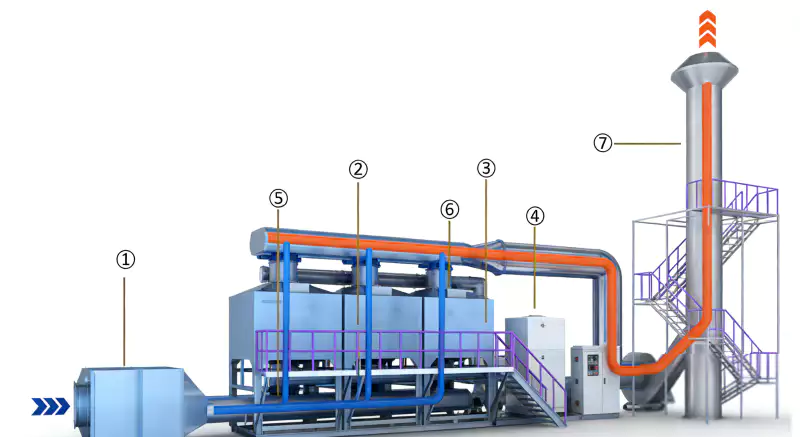
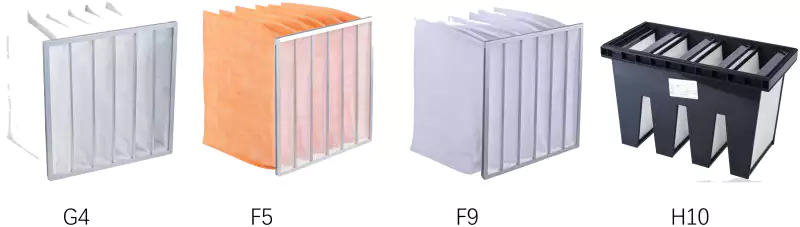
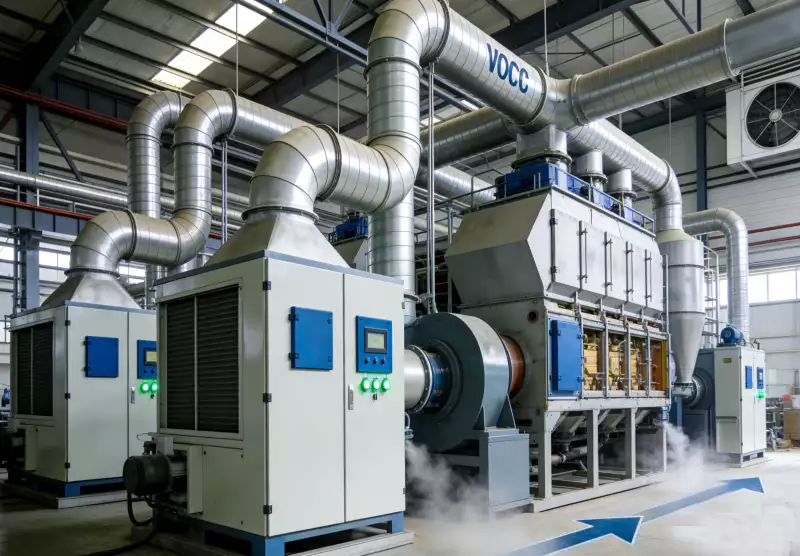
- 1. Multi-Stage Dry Filter: A modular sheet metal cabinet containing G4, F5, F9, and H10 synthetic fiber filters. It ensures particulate matter is strictly removed before reaching the Zeolite. Differential pressure transmitters automatically alert operators when filter replacement is necessary.
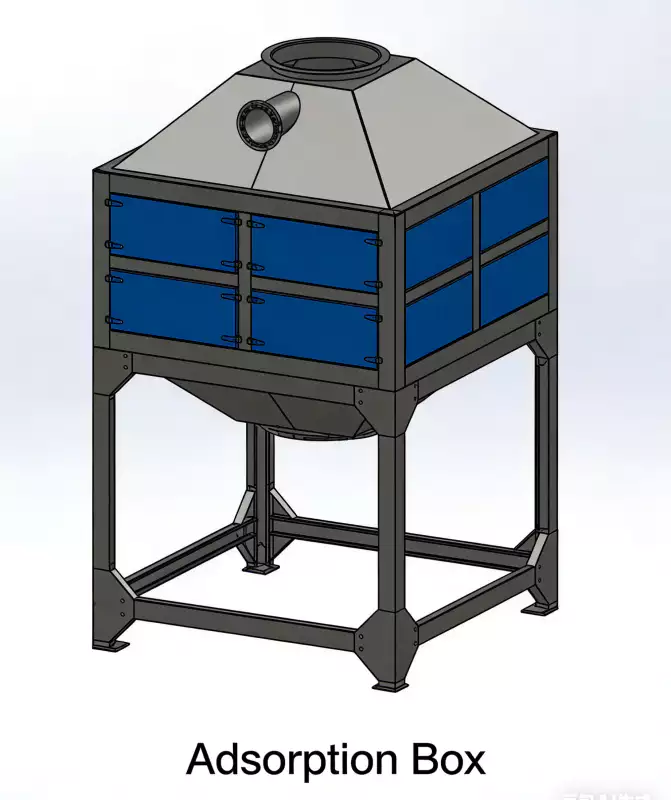
- 2. Adsorption Boxes (A/B/C Configuration): Carbon steel boxes containing multiple layers of honeycomb Zeolite molecular sieves. They feature maintenance manholes and integrated platforms for easy access. The multi-box setup allows continuous plant operation (e.g., A and B adsorb while C desorbs).
- 3. High-Temperature Valve System: Precision pneumatic pneumatic valves orchestrate the seamless transition of each adsorption box between Adsorption, Desorption, and Cooling states.
- 4. Catalytic Combustion Device (CO): The thermal core containing the heat exchanger, auxiliary burner (or electric heater), and the precious metal catalyst bed where the actual VOC destruction takes place.
- 5. Main Fan & Desorption Fan: Heavy-duty industrial fans controlled via VFD to maintain consistent aerodynamic flow across the entire system.
? Working Principle
- Pretreatment: Raw exhaust gas passes through the dry filter, intercepting dust particles > 1μm to protect the porous structure of the molecular sieve.
- Adsorption: The clean, dilute exhaust gas is directed into Adsorption Boxes A and B. The honeycomb Zeolite captures the organic molecules. The purified air exits through the chimney.
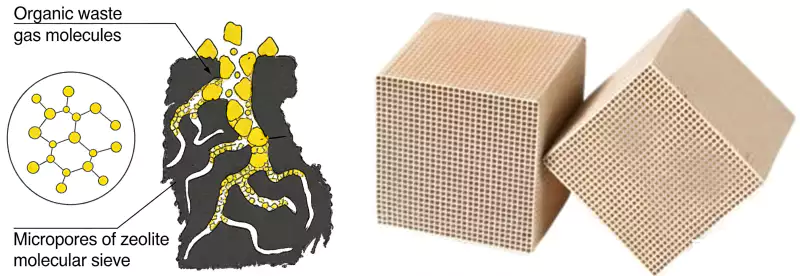
- Desorption & Concentration: When Box A approaches saturation, the system automatically isolates it. A low-volume, hot airstream (150°C – 200°C) is blown through Box A, releasing the trapped VOCs. Box C (previously in standby) comes online to replace Box A in the adsorption cycle.
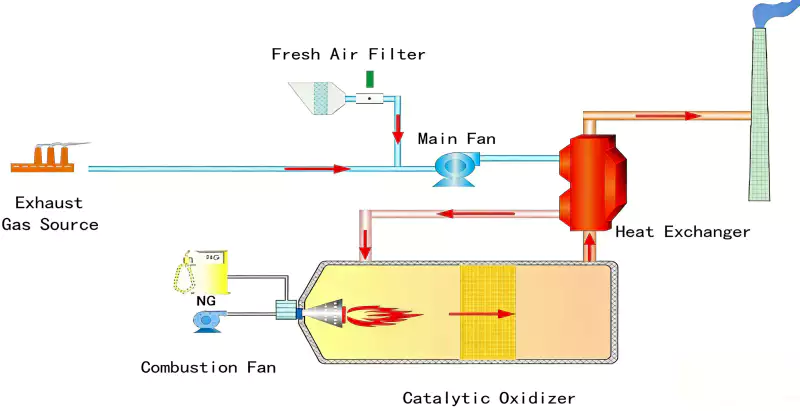
- Catalytic Decomposition: The now highly-concentrated, low-volume VOC stream is pushed into the Catalytic Oxidizer. Here, it is heated to 250-300°C and passes over the catalyst, breaking down into CO2 和 H2O and releasing immense thermal energy.
- 熱回收: The hot purified gas leaving the catalyst passes through a heat exchanger, transferring its heat to the incoming desorption air, establishing a highly energy-efficient closed-loop system.
⚛️ Catalytic Technology Principle
Catalytic combustion achieves over 95% VOC removal efficiency at relatively low temperatures (300-500°C). It is one of the most energy-saving and efficient waste gas treatment technologies available.
The Role of the Zeolite: Natural zeolite is an inorganic microporous material (SiO2, Al2哦3). It possesses a uniform pore size (0.3 – 1nm) and an internal electrostatic field. This grants it “shape-selective” and “polar-selective” adsorption—grabbing VOC molecules based on their size, polarity, and unsaturation, while letting air pass. Furthermore, Zeolite is completely non-flammable, fundamentally eliminating the severe fire risks associated with traditional Activated Carbon desorption.
The Role of the Catalyst: In the CO reactor, the concentrated organic gas passes through a precious-metal-coated porous carrier. The catalyst adsorbs oxygen and organic gases onto its surface, lowering the activation energy required for combustion. This causes a vigorous, flameless chemical reaction:
VOCs + O2 → CO2 + H2O + Heat
? Scope of Application
Target Industries
Extensively deployed in spray painting (automotive 4S shops, heavy equipment), furniture manufacturing, electronics manufacturing, printing, food processing, and rubber vulcanization exhaust.
Target Pollutants
Highly effective for volatile organic solvents including Benzene series, Esters, Alcohols, Aldehydes, Ethers, Alkanes, and their complex industrial mixtures.
Constraint: Catalyst Poisons
Not suitable for gas streams containing significant Catalyst Poisons: Sulfides (H2S, RSH), Phosphorus, Arsenic, Halogens, Heavy Metals, or heavy Siloxane vapors.
? Performance Showcase
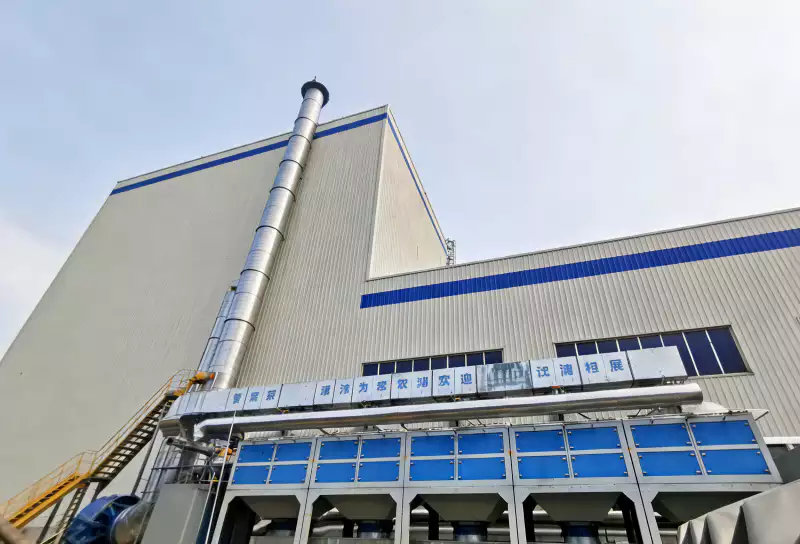
Hebei Hongxing Automobile
行業: Automotive Coating
Air Volume: 200,000 m3/h
污染物: Benzene compounds, Ethyl acetate
The Zeolite system successfully concentrated the massive booth exhaust, reducing the oxidizer size required by 90% and slashing fuel costs.
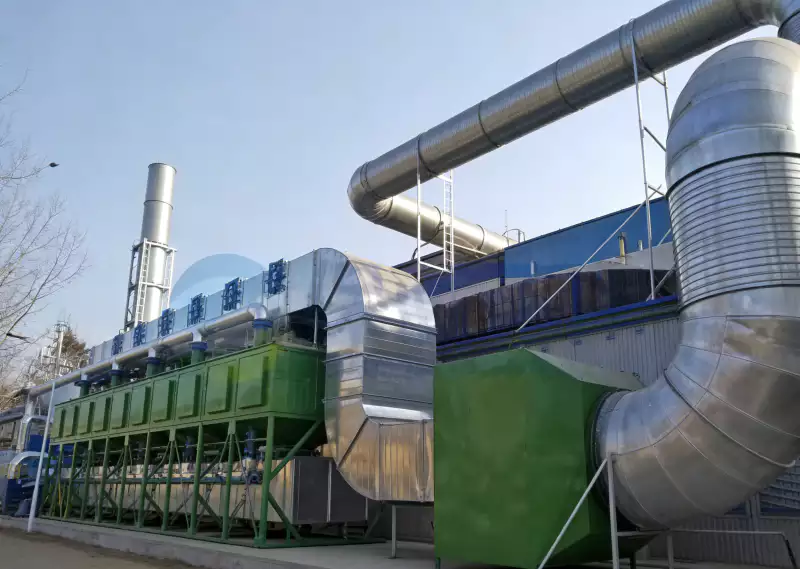
Hongtian Heavy Industry
行業: Equipment Coating
Air Volume: 60,000 m3/h
污染物: Benzene compounds, mixed VOCs
Replaced a hazardous activated carbon system. The non-flammable Zeolite guaranteed 100% fire safety during hot-air desorption.
Chengdu Zhongxin
行業: Renewable Resources
Air Volume: 40,000 m3/h
污染物: Benzene compounds, fatty compounds
The integrated multi-stage dry filter effortlessly handled complex particulates before the gas entered the Zeolite beds.
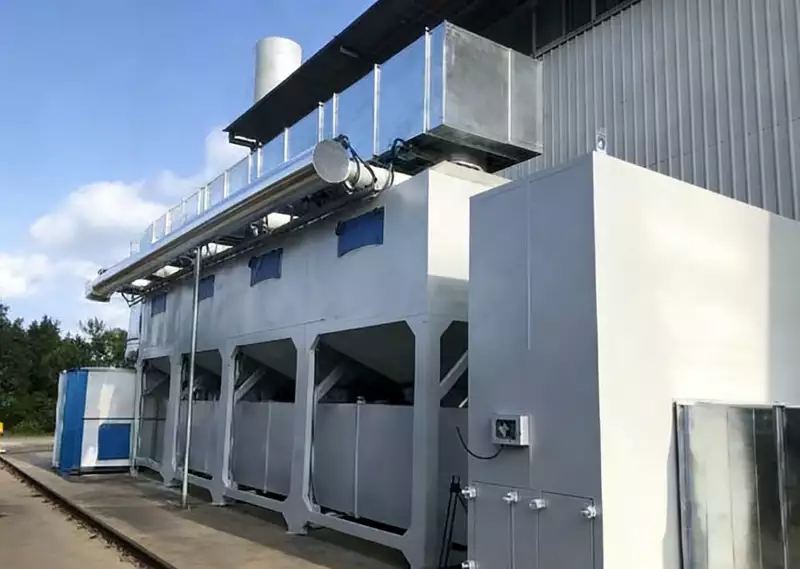
Shandong Taikai
行業: Industrial Coating
Air Volume: 20,000 m3/h
污染物: Mixed VOCs, Ethyl acetate
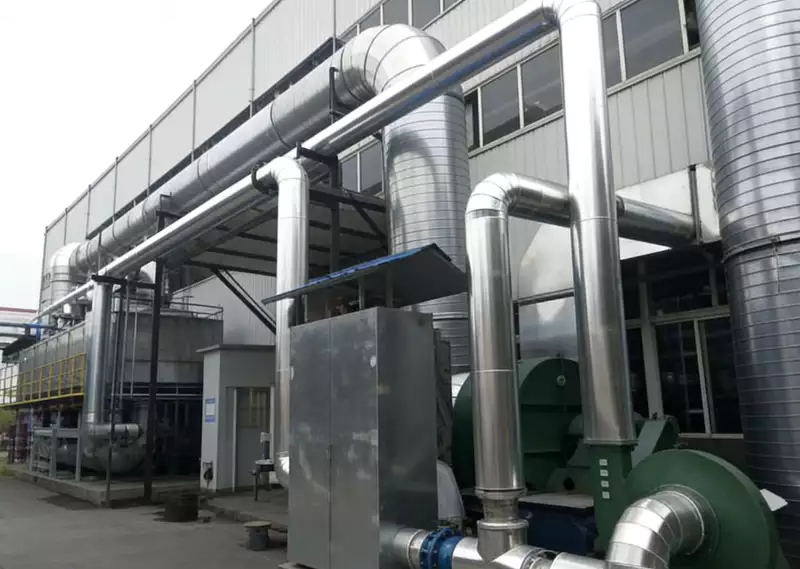
Achieved complete autothermal (self-heating) operation during desorption, resulting in near-zero natural gas consumption.
? Why Partner with Ever-power?
For over 20 years, Ever-power has been the premier engineering authority in heavy industrial air purification. Designing a combined Adsorption-Desorption and Catalytic system requires mastering precision pneumatics, thermodynamics, and catalytic chemistry.
- ✔️ Full Value-Chain Integration: We are true EPC contractors. We deliver Process Engineering ➔ Lean Manufacturing ➔ Turnkey Site Installation ➔ Intelligent Commissioning.
- ✔️ Proven by Industry Giants: Our bespoke BL Series VOC systems successfully safeguard the compliance of massive conglomerates, including Shanshui Group, Huarun Power, and top-tier automotive manufacturers.
- ✔️ Uncompromised Quality Credentials: Fully ISO certified, holding multiple environmental patents, and fundamentally compliant with the strictest EPA/EU regulations worldwide.
? Engineering Selection Guide: Architecting Your System
To engineer the precise Zeolite & CO system for your facility, our technical team requires specific operational data to calculate the optimal concentration ratio. Prepare the following parameters:
1. Flue Gas Volumetrics & Dynamics
Provide the Maximum Gas Volume (Nm3/h) and normal operating volume. This dictates the number of adsorption boxes required (e.g., a 4-box system where 3 adsorb while 1 desorbs) and the sizing of the main VFD fan.
2. VOC Composition & Concentration (Crucial)
Provide a detailed breakdown of the VOC species and the Total Inlet Concentration (mg/Nm3). We must identify any “poisons” present (heavy metals, sulfur, halogens, silicone) to ensure the Zeolite micropores and the precious metal catalyst remain uncompromised.
3. Dust Loading & Humidity
Zeolite is highly effective, but excess dust will physically blind it, and extreme humidity will compete with VOCs for adsorption sites. Let us know your upstream conditions so we can appropriately size the G4/F9/H10 dry filters or recommend a dehumidification step.
? Value Quantified: Return on Investment (ROI)
Upgrading from legacy systems to a Zeolite + CO configuration presents a transformational shift in plant OPEX and safety.
The Cost of Outdated Technology
- Direct Combustion Bleed: Running a 100,000 m3/h low-concentration stream through a direct Thermal Oxidizer (TO) or even an RTO means you are burning massive amounts of natural gas to heat empty air. Profitability is incinerated daily.
- Activated Carbon Hazards: Using cheap Activated Carbon requires frequent, highly expensive secondary hazardous waste disposal. Worse, desorbing activated carbon with hot air carries a severe, well-documented risk of spontaneous combustion and factory fires.
The Ever-power Upgrade ROI
- 1/20th the Energy Consumption: By concentrating the gas 10x to 20x, the CO reactor size is drastically reduced. The combustion heat is recycled to desorb the Zeolite, resulting in near-zero auxiliary fuel costs. The system pays for itself rapidly in fuel savings alone.
- Absolute Fire Safety: Zeolite is an inorganic ceramic mineral. It is 100% non-flammable. You completely eliminate the fire hazards associated with carbon beds, lowering insurance premiums and ensuring facility safety.
❓ Engineering & Operational FAQ
Why use Zeolite instead of Activated Carbon?
Activated carbon is cheap but highly flammable, making hot-air desorption extremely dangerous. Zeolite is an inorganic ceramic that is entirely non-flammable, withstands much higher desorption temperatures (ensuring a cleaner, more complete purge of VOCs), and has a significantly longer service life.
What is the “Concentration Ratio”?
It is the ratio between the large volume of incoming dilute gas and the small volume of hot desorption air used to strip the VOCs. A 10:1 ratio means a 50,000 m3/h exhaust stream is concentrated down to a 5,000 m3/h stream, meaning you only need to purchase and fuel a 5,000 m3/h Catalytic Oxidizer, saving massive CapEx and OpEx.
How often does the Zeolite or Catalyst need replacing?
Assuming proper upstream filtration (no severe dust blinding) and the absence of chemical poisons (silicone, heavy metals), both the Honeycomb Zeolite and the Precious Metal Catalyst typically operate efficiently for 3 to 5 years before requiring module replacement.
What happens if the VOC concentration spikes?
Safety is integrated via PLC control. If inlet concentrations surge dangerously high, the system automatically triggers fresh air dilution valves to cool the stream, or bypasses the concentration loop entirely to prevent thermal runaway and protect the catalyst bed.
Is the desorption process offline or online?
The Ever-power system utilizes an automated Online Desorption process. Using a multi-box setup (e.g., A/B/C), pneumatically actuated valves isolate one box for hot-air desorption while the other boxes seamlessly continue to adsorb factory exhaust, ensuring zero downtime for your production line.
Eliminate Low-Concentration VOCs & Slash Costs Today
Stop burning auxiliary fuel to heat empty air and end the fire hazards of activated carbon. Let Ever-power’s senior engineering team design a bespoke Zeolite Adsorption-Desorption system that concentrates your waste, guarantees > 95% VOC destruction, and secures your plant’s profitability and environmental compliance safely.
 ZH_TW
ZH_TW  EN
EN  ZH
ZH  ES
ES  AR
AR  ID
ID  PT
PT  FR
FR  JA
JA  RU
RU  DE
DE  MS
MS  CS
CS  BG
BG  NL
NL  KO
KO  RO
RO  SK
SK  TH
TH  VI
VI  UK
UK