
Beschrijving
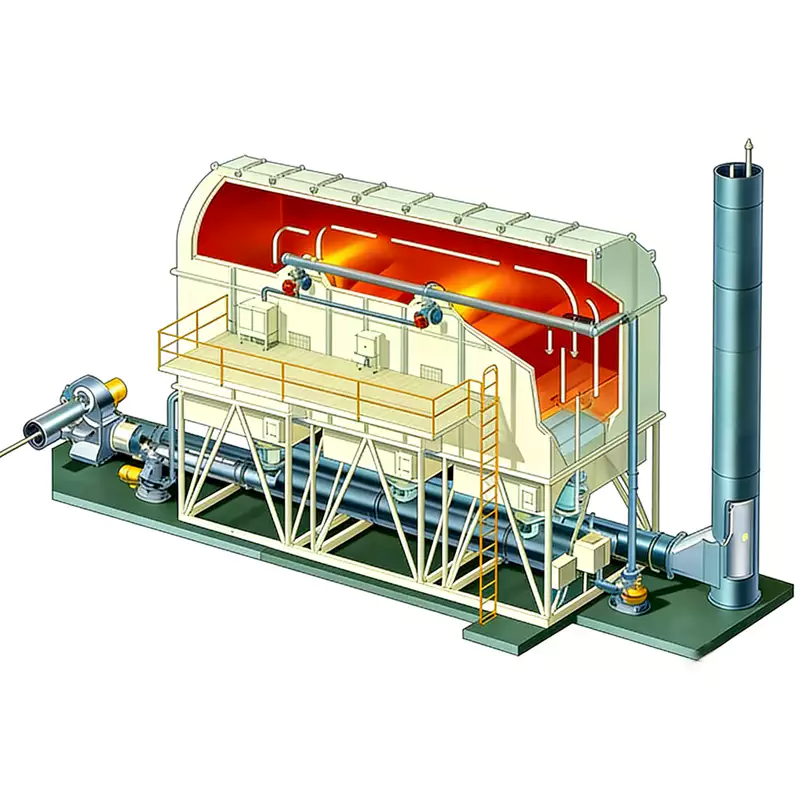
3-Bed RTO Regenerative Thermal Oxidizer | VOC Treatment Process
Eradicate Volatile Organic Compounds (VOCs) with absolute certainty while slashing your natural gas consumption to zero. Engineered by Ever-power, our 3-Bed Regenerative Thermal Oxidizer (RTO) utilizes a dedicated purge cycle to guarantee > 99% destruction efficiency and up to 95% thermal energy recovery. Stop bleeding operational budget on heating empty air, eliminate regulatory compliance risks, and achieve self-sustaining auto-thermal oxidation.
⚙️ Executive Engineering Brief
🌊 Volumetric & Concentration
- Air Volume Range: 1,000 to 100,000 Nm³/h
- Concentration Range: 1,000 mg/Nm³ to < 25% LEL
- Flow Elasticity: 30% – 120% adaptability
- Autothermal Point: ~1.5 g/m³ (Toluene Eq.)
🎯 Purification Performance
- Destruction Efficiency: > 99%
- Thermal Recovery: Up to 95%
- Reaction Temp: ≥ 760 °C
- System Pressure Loss: ≤ 3000 Pa
🛡️ Core Equipment Specs
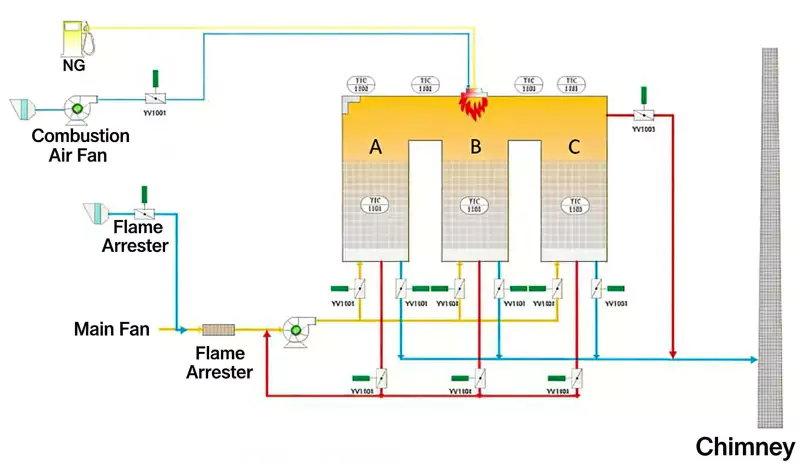
- Valves: 9 Zero-leakage Poppet Valves
- Heat Media: Honeycomb Ceramic
- Burner: Proportional Regulating (30:1)
- Insulation: 300mm High-Alumina Fiber
📊 Main Technical Specifications
The Ever-power 3-Bed RTO is engineered to deliver unwavering performance under volatile industrial conditions. Our specifications reflect a design focused on extreme longevity, massive thermal mass, and continuous environmental compliance.
| Technical Parameter | Specification Range | Engineering Impact & Plant Value |
|---|---|---|
| Processing Air Volume | 1,000 – 100,000 Nm³/h | Highly scalable multi-bed design accommodates both boutique manufacturing lines and massive chemical plant exhaust headers. |
| Combustion Temperature | ≥ 760 °C (Up to 850 °C) | Ensures absolute destruction of highly stable VOC hydrocarbon bonds, avoiding partial oxidation and toxic byproducts. |
| Thermal Recovery Efficiency | Up to 95% | Massive reduction in natural gas consumption. Process becomes entirely self-sustaining at approximately 1.5 g/m³ VOC loading. |
| Valve Leakage Rate | ≤ 1% | Precision-machined lift poppet valves with pneumatic actuators prevent raw, untreated gas from bypassing the combustion chamber. |
🔬 Regenerative Thermal Oxidation (RTO) Process
Regenerative Thermal Oxidation (RTO) is the universally mandated global standard for managing complex, mid-to-high volume Volatile Organic Compounds. The process relies on pure thermal thermodynamics, avoiding the rapid poisoning and blinding issues associated with catalytic systems.
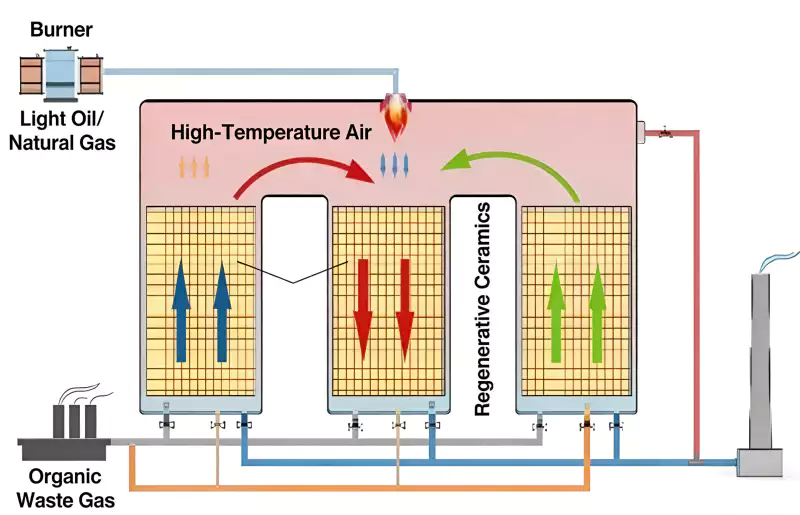
Raw, solvent-laden exhaust gas is drawn into the system by the main fan and forced upward through a pre-heated bed of honeycomb ceramic material. This ceramic matrix transfers its stored thermal energy to the gas, rapidly raising its temperature. Once the gas enters the central upper combustion chamber, a proportional gas burner elevates the temperature to 760 °C or higher. At this critical threshold, the carbon-hydrogen bonds in the VOC molecules instantly shatter, oxidizing completely into harmless Carbon Dioxide (CO&sub2;) and Water Vapor (H&sub2;O), releasing an immense amount of exothermic heat.
The resulting clean, extremely hot gas then flows downward through a secondary ceramic bed. The ceramic acts as a thermal sponge, absorbing this intense heat and cooling the gas for safe stack discharge. Through synchronized valve switching, the flow direction reverses, allowing the incoming dirty gas to harvest the stored heat. This regenerative cycle achieves an astonishing 95% thermal recovery rate.
⚖️ Comparison of Thermal Storage Oxidation Processes
Not all RTO systems deliver the same compliance security. Selecting the correct bed architecture dictates whether your facility passes or fails continuous emission telemetry audits.
| Comparison Metric | 2-Bed RTO (Legacy) | Ever-power 3-Bed RTO |
|---|---|---|
| Structure & Valves | Simple structure. Uses 4 main switching valves. | Robust structure. Uses 9 control valves to manage a dedicated purge cycle. |
| Purification Efficiency | ≤ 95%. When valves switch, a “puff” of untreated gas escapes directly to the stack. | > 99%. The third bed purges raw gas back into the burner, preventing any untreated escape. |
| Pressure Fluctuation | Significant. Valve slamming disrupts upstream printing/coating lines. | Relatively small. Modulated valve timing and VFD fan control mitigates switching shocks. |
📈 Factors Affecting RTO Combustion Efficiency
Reaction Temperature
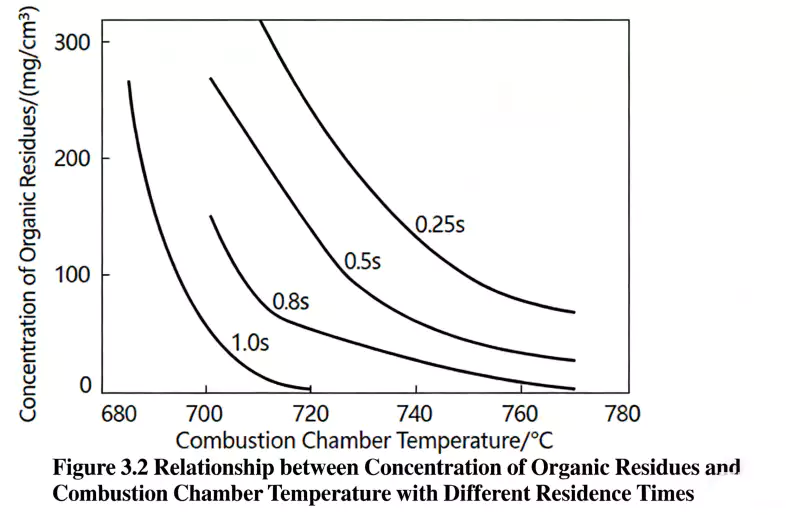
Thermodynamics dictate that increasing the combustion chamber temperature exponentially accelerates the oxidation reaction. Operating faithfully above 760°C ensures the complete destruction of rigid VOC hydrocarbon bonds.
Residence Time
The longer the gas remains in the hot zone, the higher the purification efficiency. Our engineers meticulously calculate reactor dome volumes to guarantee ample residence time (typically 0.8s to 1.2s) even at peak operational flow rates.
Turbulent Mixing
Perfect oxidation requires perfect oxygen contact. Aerodynamic shaping within the Ever-power RTO combustion chamber generates deep turbulent mixing, massively increasing the collision opportunities between combustible VOC molecules and oxygen free radicals.
🌟 Advantages of the RTO Device
- ✔️ Universal Compatibility: It can handle almost all exhaust gases containing organic compounds, completely immune to catalyst poisons like sulfur, halogens, or heavy metals.
- ✔️ High Volume Tolerance: Excellently tailored for massive air volumes with low-to-medium VOC concentrations.
- ✔️ Extreme Elasticity: The treatment capacity exhibits massive flexibility, smoothly handling flow rate variations from 30% to 120% of design capacity.
- ✔️ Peak Efficiency: Delivers the highest thermal energy recovery in the industry (95%) and absolute purification efficiency (>99%).
- ✔️ Self-Heating Magic: At an exhaust concentration equivalent to ~1.5g/m³ of Toluene, the burner shuts off. The system sustains 760°C operation using zero natural gas.
- ✔️ Ease of Maintenance: Organic sediments can be easily “baked out,” and the ceramic thermal storage medium has an extraordinarily long service life.
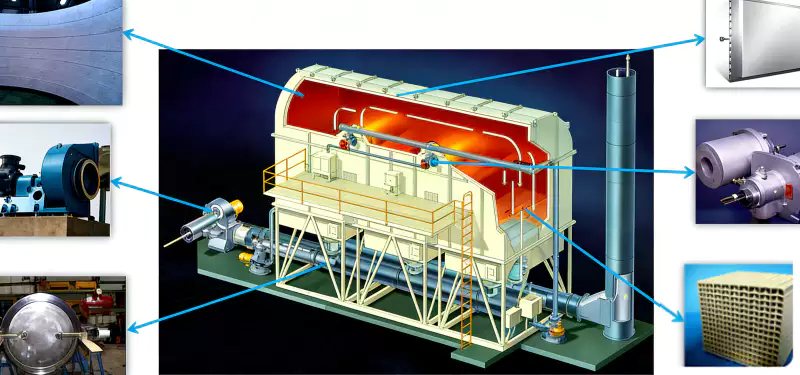
⚙️ Components of the 3-Bed RTO
1. Insulation Cotton (Refractory Lining)
The RTO box utilizes high-alumina aluminum silicate fiber insulation modules with a maximum thickness of 300mm. This provides vastly superior insulation performance compared to ordinary fibers. These modules feature low thermal conductivity, high compressive strength, and excellent resistance to thermal flow scouring. Their pre-compressed installation ensures no gaps exist in the furnace lining, locking 760°C heat inside and keeping exterior casing temperatures safe for operators.
2. Valve System (Lift Poppet Valves)
The 9-valve switching mechanism is the critical lung of a 3-Bed RTO. Ever-power utilizes heavy-duty lift poppet valves featuring high precision and minimal leakage (≤ 1%). Because the valve plate gravity aligns with the pneumatic cylinder operating direction, no sliding support is needed, ensuring maximum mechanical stability over 500,000+ cycles. The 12mm thick valve plates resist high-temperature deformation and provide rapid switching (≤ 1s). Crucially, in the event of power or gas loss, the valve plates close securely under their own weight, providing fail-safe physical closure protection for the factory.
3. Regenerative Body (Ceramic Media)
Acting as the regenerative heat exchanger, these precision-extruded ceramic honeycomb fillers capture intense heat from exiting purified gases during the “hot cycle” and rapidly release it to pre-heat incoming cold toxic gases during the “cold cycle.” This alternating mechanism achieves the staggering 95% thermal recovery rate.
4. Burner & Fan Systems
A low-pressure proportional regulating gas burner (30:1 regulation range) ensures stable combustion, dynamically adjusting gas flow based on PLC commands to save fuel. The main exhaust fan adopts critical fire-resistant designs (copper-inlaid inlets, cast aluminum impellers), significantly enhancing explosion-proof safety.
5. Bursting Disc & Instrumentation/Control
For critical safety, an explosion venting disc (compliant with HG/T20570.3) is installed to immediately vent catastrophic overpressure events. Bimetallic thermometers, pressure transmitters, and LEL sensors feed continuous telemetry to the advanced PLC electronic control system, managing equipment monitoring, alarms, automatic interlock protection, and emergency shutdown functions.
⚠️ Why is an RTO Mandatory? (Global Emission Standards)
The Health & Air Quality Crisis
Volatile Organic Compounds (VOCs) are not just foul-smelling; they are the primary precursors to deadly PM2.5 particulate matter and low-level photochemical smog. When industrial solvents react with sunlight and nitrogen oxides (NOx) in the atmosphere, they create severe respiratory hazards, severely degrading local air quality and public health.
Ruthless Regulatory Enforcement
Consequently, global regulatory authorities (EPA, EEA, China MEE) have abandoned passive monitoring in favor of Continuous Emission Monitoring Systems (CEMS). Limits for Non-Methane Hydrocarbons (NMHC) are consistently dropping, frequently demanding outlet concentrations far below 50 mg/Nm³. Failing an audit via cheap, inefficient activated carbon boxes guarantees crippling daily fines, public relations disasters, and immediate, legally-mandated cessation of factory production. An Ever-power RTO is not just equipment; it is your ultimate factory insurance policy.
🔄 3-Bed RTO Switching Sequence
The fatal flaw of a 2-bed RTO is the “puff” of unburned VOCs that escapes up the chimney during the split-second the valves switch directions. The 3-Bed architecture solves this completely by dedicating a third bed specifically for purging. Before a bed becomes an exhaust bed, it is flushed with clean air, sweeping any raw VOCs back into the combustion chamber. This pushes purification from 95% up to a guaranteed > 99%.
| Time Cycle | Bed A | Bed B | Bed C |
|---|---|---|---|
| Cycle T | Inlet (Heating gas) | Outlet (Cooling gas) | Purge (Cleaning) |
| Cycle 2T | Purge (Cleaning) | Inlet (Heating gas) | Outlet (Cooling gas) |
| Cycle 3T | Outlet (Cooling gas) | Purge (Cleaning) | Inlet (Heating gas) |
🏭 Typical Application Scenarios & Industry Fit
Automotive & Industrial Coating
Spray booths and drying ovens produce massive volumes of air loaded with complex paint solvents (esters, aromatics). The 3-Bed RTO processes these massive flows effortlessly, stabilizing the plant’s emission profile.
Chemical & Pharmaceutical
Reactor venting creates sudden spikes in complex VOC concentrations that lack recovery value. The RTO buffers these spikes through its immense thermal mass, destroying complex halogens safely.
Printing & Packaging
High-speed flexographic and gravure printing evaporate tons of solvents hourly. The steady, mid-concentration flow perfectly matches the RTO’s self-heating threshold, yielding near-zero monthly gas bills.
🏆 Successful Case Display
Zhejiang Bili Polymer (China)
Industry: Industrial Printing
Air Volume: 60,000 m³/h
Exhaust: Esters, Alcohols
The high 60,000 m³/h load required a highly stable system. Ever-power’s 3-Bed RTO guaranteed >99% destruction, easily passing strict local environmental audits while saving massive heating costs due to the 95% heat recovery.
Xintiandi Pharmaceutical
Industry: Pharmaceuticals
Air Volume: 40,000 m³/h
Exhaust: Dichloromethane, Alcohols
Chlorinated compounds mandate specialized metallurgy to prevent acid dew-point corrosion. The bespoke 3-Bed RTO safely processes these complex halogens reliably 24/7 without degrading the internal structure.
Shandong Huineng
Industry: Chemical Processing
Air Volume: 10,000 m³/h
Exhaust: Benzene series, Hydrocarbons
Deployed a tailored 3-bed unit for their steady output. The system runs entirely on the autothermal heat generated by the dense benzene exhaust, costing zero natural gas during normal production.
Russian Chemical Plant (Russia)
Industry: Chemical
Air Volume: 18,000 m³/h
Exhaust: Benzene series, Odorous gases
The 300mm aluminum silicate insulation is phenomenal. Despite the freezing outside temperatures, the RTO maintains its internal core flawlessly, eliminating odor pollution entirely.
⚖️ Equipment Core Advantages vs. Traditional Solutions
| Comparison Metric | Ever-power 3-Bed RTO | Direct Thermal Oxidizer (TO) | Catalytic Oxidizer (RCO) |
|---|---|---|---|
| Fuel Consumption (OPEX) | Near Zero (95% Heat Recovery) | Extremely High (Continuous burning required) | Low (Requires expensive catalyst replacement) |
| Catalyst Poisoning Risk | Zero (Pure thermal process) | Zero | High (Sulfur, Heavy metals blind catalyst) |
| Purification Efficiency | > 99% (No escaping puffs due to purge) | > 99.9% | ~ 98% |
| Ideal Gas Profile | High Volume, Low/Medium Concentration | Low Volume, Extreme Concentration | Clean gas only (No dust or poisons) |
📐 Selection Guide: Architecting Your RTO
To engineer the precise thermal mass, valve sizing, and structural layout for your facility, our technical team requires robust operational data. Please prepare the following parameters to ensure system safety and maximize heat recovery:
1. Flue Gas Volumetrics & Flow Dynamics
Provide the Maximum Gas Volume (Nm³/h) and normal operating volume. Knowing the fluctuations (e.g., between painting shifts) helps us design the Variable Frequency Drive (VFD) control for the main ID fan to save significant power during low-load periods.
2. VOC Composition, Concentration & LEL
Provide the chemical species (e.g., Toluene, Xylene) and the Total Inlet Concentration (mg/Nm³). Critical Safety Note: We must calculate the Lower Explosive Limit (LEL) to design the fresh air dilution loops, guaranteeing the system always stays safely below the 25% LEL threshold.
3. Target Emission & Plant Layout
Confirm your specific local regulatory emission targets. Also, indicate the available footprint area. The 3-Bed RTO requires a robust concrete foundation, and routing massive ductwork requires careful spatial planning.
💰 Value Quantified: Return on Investment (ROI)
The Hidden Cost of Sub-Par Abatement
Energy Bleed in Direct TO: Running a standard Direct Thermal Oxidizer burns massive amounts of natural gas to heat empty air up to 760°C, destroying factory profit margins with every cubic meter processed.
Regulatory Fines from 2-Bed Units: Cheaper 2-Bed RTOs experience a brief but catastrophic drop in efficiency during valve switches, letting raw VOCs puff out the stack. This triggers modern CEMS telemetry, resulting in automated fines and compliance failures.
The Ever-power 3-Bed Upgrade ROI
Autothermal Fuel Independence: By harvesting 95% of the outgoing heat via the massive ceramic beds, a VOC concentration of merely ~1.5 g/m³ allows the burner to shut off entirely. You effectively destroy toxic gases using zero utility gas. The monumental fuel savings alone often yield full ROI within 12-24 months.
Bulletproof Compliance: The dedicated third purge bed completely isolates dirty incoming gas from the clean exhaust stack, guaranteeing an unbroken >99% purification efficiency and shielding the plant from regulatory interference.
❓ Engineering & Operational FAQ
What exactly does “Auto-thermal” mean?
Auto-thermal means the system powers itself. Because the massive ceramic regenerator beds capture 95% of the heat from the outgoing clean gas, it aggressively pre-heats the incoming cold gas. When the incoming VOC concentration reaches roughly 1.5 g/m³ (toluene equivalent), the heat generated simply by the chemical destruction of those VOCs is enough to maintain the 760°C reactor temperature. The natural gas burner shuts off completely.
How long does the ceramic honeycomb last?
Unlike delicate RCO catalysts which can be chemically poisoned by sulfur or heavy metals, honeycomb ceramic is highly robust and chemically inert. Assuming there is no heavy silica or fiberglass dust that physically melts and glazes the ceramic (which would require upstream dry filtration), the ceramic media typically lasts 5 to 10 years before requiring full replacement.
What happens if the VOC concentration spikes above 25% LEL?
Safety is integrated automatically via the PLC. If real-time telemetry detects VOC loads surging toward the Lower Explosive Limit (LEL), the system triggers proportional fresh air dilution valves to cool and dilute the stream. If temperatures exceed safe critical limits, hot-gas bypass valves open and the burner halts to prevent thermal runaway.
Are the 9 poppet valves difficult to maintain?
Ever-power utilizes heavy-duty, vertical-lift pneumatic poppet valves. Because they operate vertically with gravity, they suffer minimal sliding wear. They are rated for over 500,000 cycles and are positioned externally for straightforward inspection and pneumatic cylinder replacement without entering the hot zone.
Can I use this for low-concentration exhaust?
While an RTO can physically process low-concentration exhaust (< 1000 mg/Nm³), it becomes economically unviable because you must constantly burn natural gas to maintain the 760°C heat against the massive volume of cold incoming air. For low concentrations with huge air volumes, we strongly mandate coupling the RTO with an upstream Zeolite Rotor Concentrator to shrink the air volume and spike the concentration.
🏆 Why Partner with Ever-power?
For over 20 years, Ever-power has dominated the engineering of severe-duty environmental equipment. We possess profound technical expertise executing turnkey projects across steel, coking, power, and high-end manufacturing industries.
- ✔️ Full Value-Chain Integration: Our professional business divisions handle the entire EPC lifecycle: Complete Engineering Design ➔ Precision Manufacturing ➔ Overseas Logistics ➔ Intelligent Commissioning.
- ✔️ Advanced Control Capabilities: We manufacture and supply complete electrical control equipment. Our PLC systems guarantee automated, highly reliable thermal tracking to protect your facility.
- ✔️ Uncompromised Quality Credentials: Operating rigorously under ISO management systems, holding multiple structural patents, and ensuring every system meets global compliance standards.
🔗 Comprehensive Plant Environmental Solutions
Beyond RTO systems, Ever-power architects industry-leading gas treatment configurations for complex chemical, particulate, and organic emissions across all heavy industries:
- Advanced VOC Treatment Systems – Total lifecycle solutions for industrial organic emissions.
- RTO (Regenerative Thermal Oxidizer) – Discover our Rotary thermal efficiency solutions for highly compact layouts.
- RCO (Regenerative Catalytic Oxidizer) & CO (Catalytic Oxidizer) – Low-temperature catalytic oxidation for clean VOC streams.
- TO (Thermal Oxidizer) – Direct-fired high-heat incineration for extreme concentration, highly toxic waste streams.
- Learn more about our legacy and engineering ethos: About Ever-power.
- Visit our homepage: Ever-power Global.
Eradicate Emissions & Slash Energy Waste
Stop settling for inefficient 2-bed systems that fail compliance audits with untreated exhaust puffs. Let Ever-power’s senior engineering team design a bespoke 3-Bed RTO that guarantees > 99% destruction, totally purges raw gas, and drives your auxiliary heating costs to absolute zero.
 NL
NL  EN
EN  ZH
ZH  ES
ES  AR
AR  ID
ID  PT
PT  FR
FR  JA
JA  RU
RU  DE
DE  MS
MS  CS
CS  BG
BG  KO
KO  RO
RO  SK
SK  TH
TH  VI
VI  ZH_TW
ZH_TW  UK
UK