
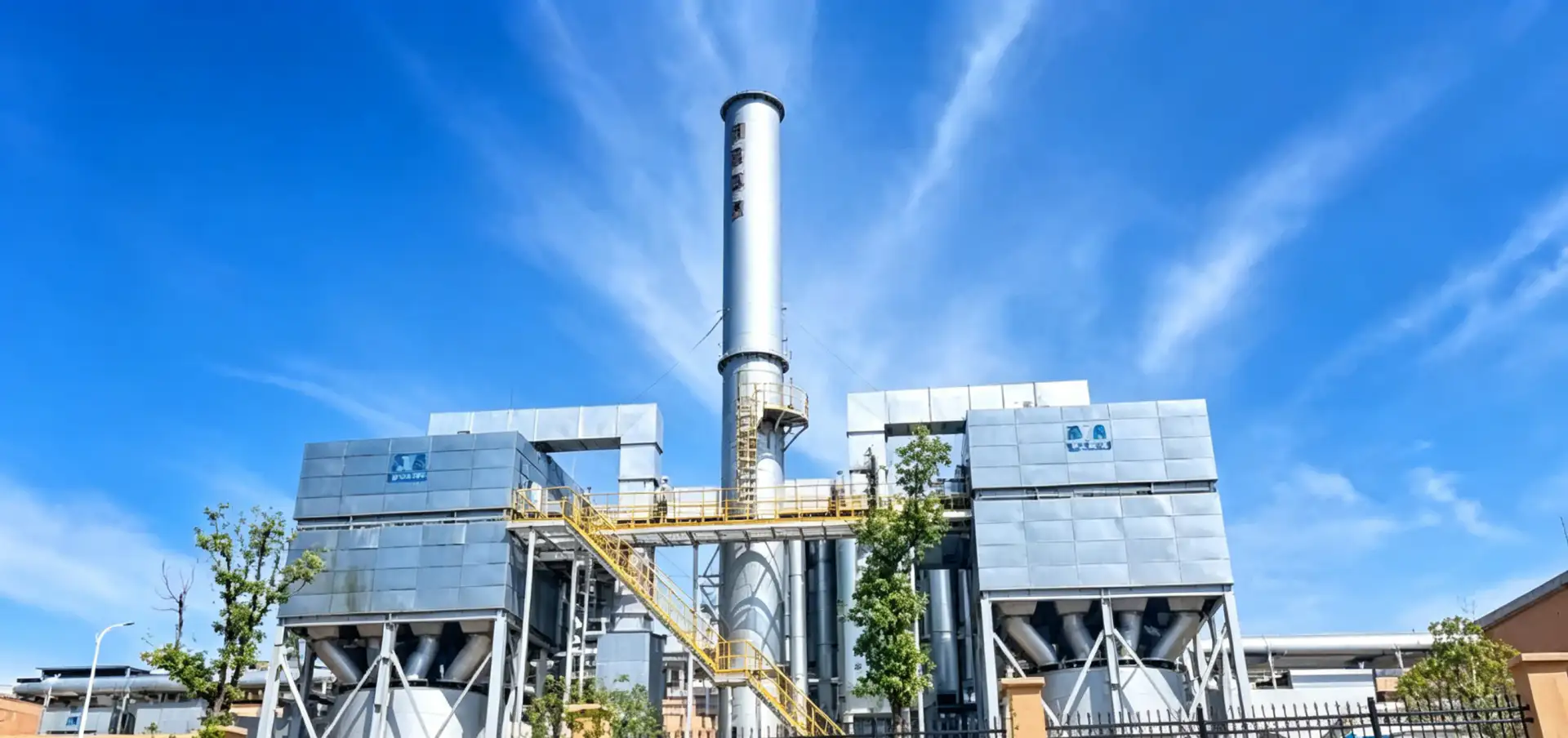
What Is a Oxydateur thermique régénératif (RTO)?
Learn about regenerative thermal oxidizers (RTOs) and how our high-performance systems control VOCs, odors, and hazardous emissions while recovering energy.
Explore RTO SystemsWhat Is a Regenerative Thermal Oxidizer (RTO)?
UN Oxydateur thermique régénératif (RTO) is an advanced air pollution control system designed to remove volatile organic compounds (VOCs) and other hazardous pollutants from industrial exhaust gases. Operating at high temperatures around 800°C, RTOs efficiently oxidize organic compounds into harmless carbon dioxide (CO₂) et water vapor (H₂O), ensuring safe emissions.
The key advantage of an RTO lies in its regenerative heat recovery system. Ceramic heat exchangers store thermal energy and preheat incoming exhaust gases, achieving heat recovery efficiency of over 95%. Compared with conventional incinerators, RTOs not only provide superior pollutant removal but also significantly reduce fuel consumption, delivering both energy savings et environmental compliance.
Explore RTO Details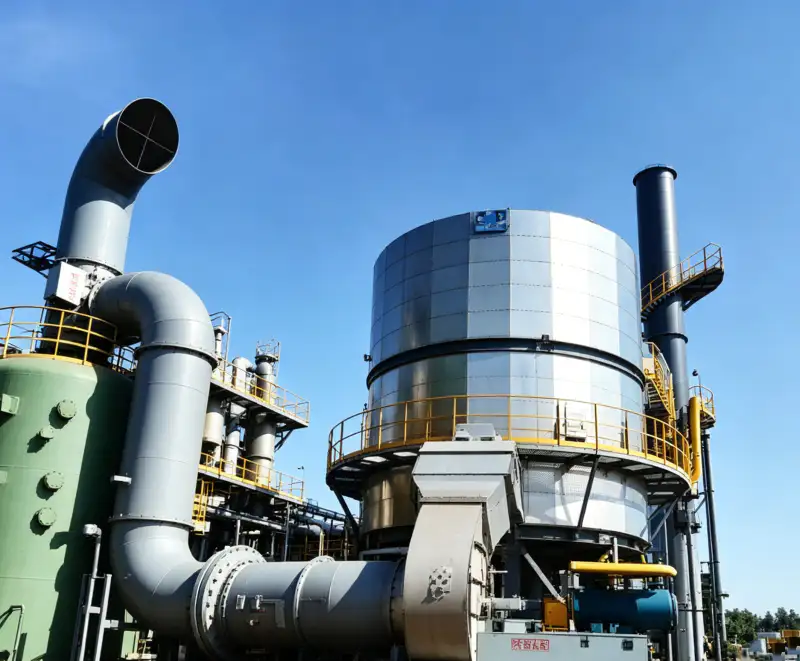
How Does a Oxydateur thermique régénératif (RTO) Travail?
A Regenerative Thermal Oxidizer (RTO) operates through repeated cycles of preheating, oxidizing, and heat recovery to efficiently destroy industrial pollutants while minimizing energy consumption.
Préchauffage
A burner heats the ceramic media inside the RTO until the system reaches its optimal operational temperature, ensuring readiness to oxidize VOCs and hazardous gases.
Oxidation of VOCs
Exhaust gas passes through hot ceramic media into the combustion chamber. At around 800°C, VOCs break down into CO₂ et H₂O, safely neutralizing pollutants.
Heat Recovery & Exhaust
Purified hot gas transfers heat to a second ceramic bed. The system reverses airflow direction when saturated, repeating the regenerative heat recovery cycle for maximum efficiency.
Continuous Operation
RTOs achieve over 95% thermal efficiency, delivering both environmental compliance et cost-effective VOC destruction for industrial applications.
Through this 4-step regenerative cycle, RTOs deliver over 95% thermal efficiency, achieving both environmental compliance et cost-effective VOC destruction for industrial applications worldwide.
RTO System Structure & Key Components
Explore the six core components of our regenerative thermal oxidizer. Click each section to expand and learn about its function and Ever-Power advantages.
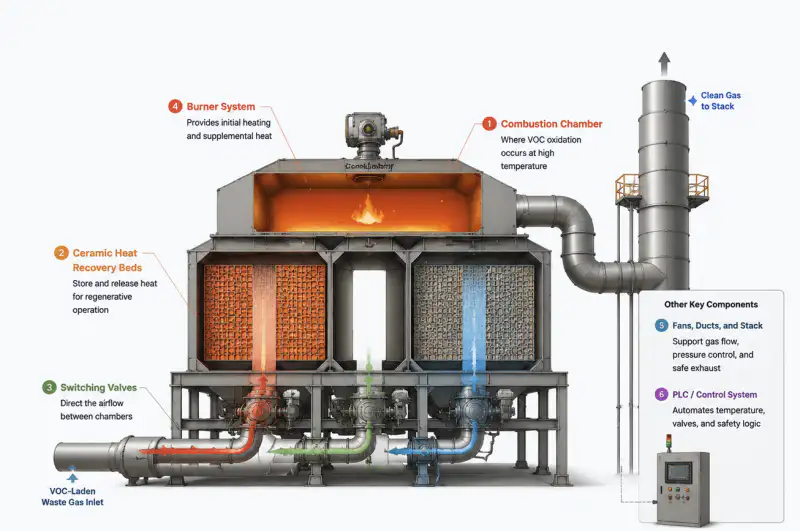
Chambre de combustion
The heart of the RTO where VOC oxidation occurs at high temperatures (760–850°C). Lined with high-grade refractory ceramic fiber modules that withstand thermal shock and minimize heat loss.
Modular refractory design with 5+ year service life. Optimized geometry ensures uniform temperature distribution et ≥99.5% DRE efficiency.
Ceramic Heat Recovery Beds
Dual ceramic media beds (A and B) that alternately store and release thermal energy. Structured ceramic packing provides massive surface area for heat exchange between incoming and outgoing gas streams.
Honeycomb monolith ceramic media achieves ≥95% thermal efficiency. Low-pressure-drop design reduces fan energy by 15–20%. Media life exceeds 10 years.
Switching Valves
High-speed pneumatic valves reverse airflow direction between the two ceramic beds every 60–180 seconds. This switching action makes the system "regenerative" — continuously recovering heat from the exhaust stream.
Zero-leakage poppet valve technology avec <0.5% cross-contamination. <1 second switching time minimizes pressure fluctuations. Rated for 1 million+ cycles.
Système de brûleur
Provides initial heating during startup and supplemental heat when VOC concentration is insufficient for autothermal operation. Injects natural gas or LPG with precise air-fuel ratio control.
Low-NOx burner avec NOx emissions <30 mg/Nm³. UV flame detection ensures 100% ignition reliability. 10:1 turndown ratio adapts to varying VOC loads.
Fans, Ducts, and Stack
The exhaust handling system includes ID/FD fans, insulated ductwork, and a tall exhaust stack. Ensures safe gas flow, pressure control, and proper dispersion of treated exhaust into the atmosphere.
VFD fans deliver 30% energy savings at partial load. 200mm ceramic wool insulation keeps surface <60°C. Stack height engineered for local dispersion compliance.
PLC / Control System
The intelligent brain of the RTO. Automates temperature control, valve sequencing, safety interlocks, alarm management, and data logging. HMI touchscreen provides real-time monitoring of all critical parameters.
Siemens S7-1500 PLC avec remote IoT monitoring via 4G/WiFi. Predictive maintenance detects media degradation 3 months early. Full data logging for environmental audits et 24/7 remote diagnostics.
Types de Oxydateur thermique régénératif (RTO)
Compare the three main RTO configurations to find the optimal solution for your industrial air pollution control needs.
| Type | 2-lits RTO | 3 lits RTO | Rotary RTO | Remarque |
|---|---|---|---|---|
| Technology of Iteration | First Generation Gen 1 | Second Generation Gen 2 | Third Generation Gen 3 | — |
| Number of Regenerators | 2 | 3 | 12 | More regenerators = higher heat recovery |
| Purification Efficiency | 95% | 99% | 99.5% | Higher efficiency meets stricter emission standards |
| Efficacité thermique | Temperature difference between inlet and outlet ≤30°C | |||
| Occupation of Land | 100% (benchmark) | 130% | 65% | Take 2-Beds RTO as the benchmark. Rotary RTO saves 35% floor space. |
| Investissement initial | Low | Moyen | Moyen-élevé | Rotary RTO offers best long-term ROI via energy savings |
| Maintenance Complexity | Low | Moyen | Moyen | Fewer valves in Rotary RTO reduces maintenance points |
| Best Application | Small to medium VOC loads, budget-sensitive projects | Medium to large VOC loads, moderate efficiency requirements | Large-scale continuous operations, strict emission limits, space-constrained facilities | — |
Ever-Power offers all three RTO configurations with custom engineering to match your specific VOC profile, flow rate, and regulatory requirements. Contact us for a free technical consultation to determine the optimal RTO type for your facility.
Choose the Right RTO Type for Your Application
Ever-Power offers three proven RTO configurations, each optimized for different industrial scenarios. Compare their strengths and find your ideal match.
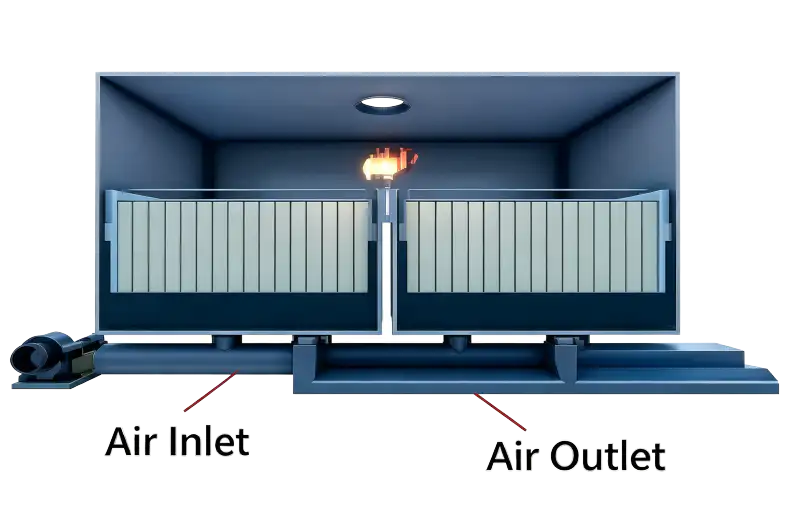 Gen 1
Gen 12-Bed RTO
First Generation — Cost-Effective Classic
Small to medium VOC loads, budget-sensitive projects, industries with moderate emission standards (e.g., small coating lines, printing shops, chemical batch processes).
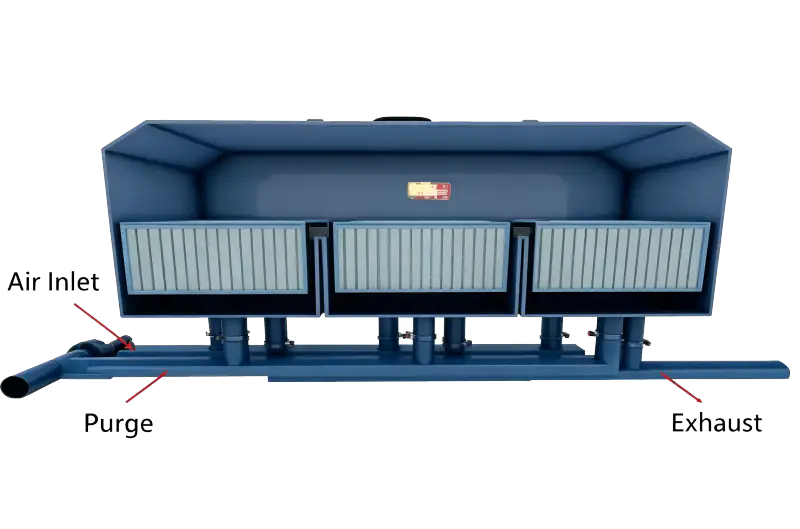 Gen 2
Gen 23-Bed RTO
Second Generation — Balanced Performance
Medium to large VOC loads, industries with strict emission limits (e.g., automotive painting, pharmaceutical manufacturing, petrochemical processing).
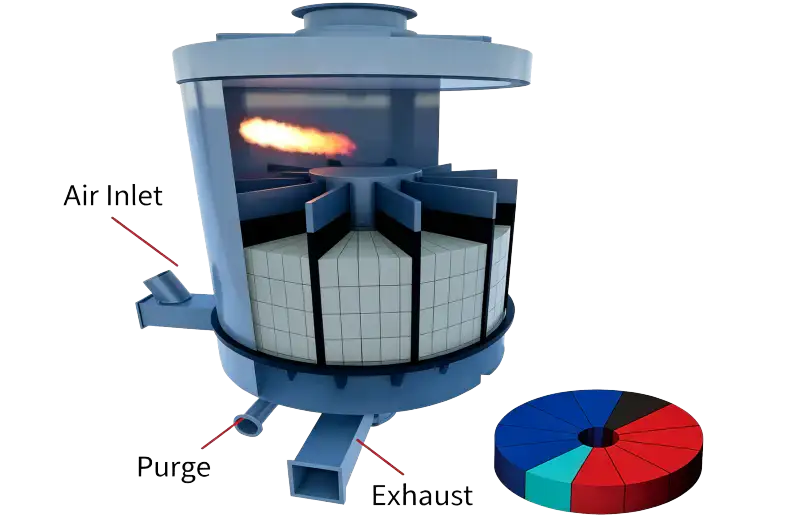 Gen 3
Gen 3Rotary RTO
Third Generation — Premium Efficiency
Large-scale continuous operations, space-constrained facilities, and industries with the strictest environmental regulations (e.g., semiconductor, lithium battery, food & beverage, large coating plants).
RTO Industry Applications
Ever-Power RTO systems are trusted across diverse industries for reliable VOC control, odor elimination, and regulatory compliance. Explore solutions tailored to your sector.
Industrie de l'impression
Solvent-based inks, varnishes, and cleaning agents release high concentrations of VOCs during drying and curing. Our RTO ensures complete oxidation of toluene, xylene, and ethyl acetate emissions.
Industrie du revêtement
Spray booths, dip lines, and curing ovens generate solvent vapors from paints, lacquers, and powder coatings. RTO handles high-volume, low-concentration exhaust streams with exceptional efficiency.
Industrie des bobines étanches
Bitumen modification and membrane production release pungent asphalt fumes and VOCs. Our RTO neutralizes odors and hazardous emissions while recovering heat for process reuse.
PVC Elastic Flooring
Calendering, printing, and foaming processes emit plasticizers, stabilizers, and residual monomers. RTO effectively treats DOP, DINP, and vinyl chloride emissions for indoor air quality compliance.
Industrie du carbone
Graphitization, impregnation, and baking furnaces release tar vapors, phenol, and complex organics. High-temperature RTO handles these heavy-molecule emissions with stable destruction efficiency.
Labor Protection Glove
Dipping and vulcanization lines release nitrile, latex, and solvent vapors. RTO treats these sticky, high-humidity exhaust streams without fouling, ensuring consistent compliance.
Industrie chimique du charbon
Coal gasification, coking, and chemical synthesis produce complex VOC mixtures including benzene homologues, heterocyclics, and malodorous sulfur compounds. RTO delivers robust treatment for these challenging streams.
Don't see your industry? Ever-Power custom-engineers RTO solutions for virtually any VOC-emitting process.
Request Custom Application Design FR
FR  EN
EN  ZH
ZH  ES
ES  AR
AR  ID
ID  PT
PT  JA
JA  RU
RU  DE
DE  MS
MS  CS
CS  BG
BG  NL
NL  KO
KO  RO
RO  SK
SK  TH
TH  VI
VI  ZH_TW
ZH_TW  UK
UK